
Domain renewal strategy is the process of deciding how long to register your domain name, when to renew it, and how to protect it from accidental expiration.
But here’s a question many website owners don’t think about until they’re about to purchase a domain:
Should you register your domain for just one year, or is it smarter to secure it for five or even ten years?
Imagine this.
You’ve spent years building your business.
Your website is attracting customers, your email accounts are connected to your domain, and people recognize your brand online.
Then one day, you discover that your domain registration has expired.
Your website may stop resolving correctly, business emails may be disrupted, and recovering your domain could become complicated or expensive.
Not exactly the kind of surprise any business owner wants!
That’s why choosing the right registration period matters.
A domain name isn’t just a website address. It’s an important part of your business identity.
Whether you’re starting a personal blog, launching an online store, or building a long-term business, a good domain renewal strategy helps you manage costs and reduce the risk of losing control of your domain.
At TezHost, we believe registering and managing a domain should be straightforward.
If you’re planning to establish your online presence, you can register with TezHost today and explore available domain extensions.
But before choosing your registration period, let’s understand what actually makes sense for your website.
Should You Register a Domain for 1 Year or Longer?
A one-year registration is often suitable for new projects, while a longer registration period may be more convenient for established businesses planning to keep their domain for several years.
Your ideal domain renewal strategy depends on three important factors:
- How long you expect to use the domain.
- How much you’re comfortable paying upfront.
- How actively you manage renewal reminders and account settings.
If you’re experimenting with a new business idea, registering for one year can give you flexibility.
If you’re building a brand you expect to operate for many years, a longer registration period may reduce how often you need to renew.
However, registering for multiple years doesn’t automatically make your website more secure, improve search rankings, or guarantee lower renewal costs.
How Long Can You Register a Domain?
For many common domain extensions, including .com, registrations can generally be maintained for up to 10 years at a time.
However, rules vary by domain extension and registry.
Some extensions have different minimum or maximum registration periods.
Before purchasing, confirm the available registration terms for your chosen extension.
The best registration length isn’t necessarily the longest one. It’s the one that matches your plans.
1. One-Year Domain Registration: Best for Flexibility
A one-year domain registration is usually a practical choice for beginners, experimental projects, and businesses that want to minimize upfront costs.
If you’re launching your first website, you might not know exactly how your project will develop.
Maybe you’re testing a business idea.
Perhaps you’re creating a temporary campaign website.
Or you’re starting a personal blog and aren’t sure whether you’ll maintain it long-term.
In these situations, a one-year domain renewal strategy can make sense.
Advantages of Registering for One Year
Lower upfront expense
You pay for one registration year rather than several.
Greater flexibility
If your plans change, you aren’t committed to paying for unused future years.
Suitable for experimentation
It’s a practical option for testing new website ideas.
What Are the Disadvantages?
- The biggest concern is forgetting to renew.
- A one-year registration requires more frequent renewal management.
- You may also face different renewal pricing when the registration expires.
Who Should Choose One Year?
- New bloggers.
- Freelancers testing ideas.
- Startup founders exploring brand names.
- Short-term campaigns.
- Experimental websites.
Our advice: If you’re unsure whether you’ll use the domain long-term, starting with one year is perfectly reasonable.
Just make sure you have reliable renewal reminders.
2. Three-Year Domain Registration: A Balanced Choice
A three-year registration can be a good middle ground for businesses that expect to keep their domain but don’t want to commit to a much longer term.
For many growing businesses, this domain renewal strategy offers a balance between convenience and upfront cost.
Imagine you’ve recently launched an online store.
Your brand is established, your website is live, and you’re confident you’ll continue operating for the next few years.
Registering for three years means you won’t need to renew the domain annually during that period.
Why Consider Three Years?
- Fewer renewal transactions.
- Less frequent administrative work.
- Greater convenience for ongoing projects.
- Potential price certainty for the years already paid, depending on the registrar’s terms.
Does a Three-Year Registration Save Money?
Not necessarily.
Some registrars offer discounts for longer registration periods.
Others charge the same annual rate regardless of whether you register for one year or three.
Always compare the total price, not just the advertised annual equivalent.
Who Should Choose Three Years?
A three-year registration may suit small businesses, professional portfolios, established blogs, and growing online stores.
The key benefit is convenience, not a guaranteed discount.
3. Five-Year Domain Registration: Planning for Long-Term Growth
A five-year registration is worth considering when your domain is central to a business or brand you expect to maintain for the foreseeable future.
A long-term domain renewal strategy can reduce the frequency of renewals and help businesses plan ahead.
Think about a company that has invested in:
- Brand development.
- Search engine optimization.
- Digital marketing.
- Business email.
- Customer relationships.
- Website development.
Changing the domain later could create significant work.
For such businesses, registering the domain for several years may be a sensible administrative decision.
What Are the Benefits?
Fewer renewal deadlines
You won’t need to renew the registration every year.
Longer planning horizon
Your domain remains registered through the paid period, provided the registration stays valid and complies with applicable rules.
Reduced administrative workload
Your team spends less time processing renewals.
What Should You Consider?
A five-year registration requires a larger upfront payment.
And if your brand changes, the unused registration period generally won’t be refundable.
Is Five Years Better for SEO?
No. Registering a domain for five years instead of one is not an established direct Google ranking factor.
Search engines focus on factors such as content quality, relevance, accessibility, and user experience.
A longer registration period should be viewed as a domain management decision, not an SEO shortcut.
Choose five years because it makes business sense, not because you expect an automatic ranking boost.
4. Ten-Year Domain Registration: Maximum Convenience for Established Brands
A ten-year registration can be useful for established businesses that are confident they will continue using their domain for many years.
For eligible domain extensions, ten years is commonly the maximum registration period that can be held at one time.
This domain renewal strategy can be attractive to companies that consider their domain an important long-term business asset.
Why Would a Business Register for Ten Years?
A domain may support several essential operations:
- The company’s main website.
- Professional email addresses.
- Customer portals.
- Online stores.
- Marketing campaigns.
- Digital products and applications.
Losing access to such a domain could cause serious disruption.
A longer registration term reduces the frequency of renewal deadlines.
Does Ten-Year Registration Mean You Own the Domain Forever?
No.
Domain registration is generally a renewable right to use a domain name under the applicable registry and registrar terms.
Registering for ten years doesn’t give you permanent ownership.
You must still renew the registration before it expires.
Are There Any Disadvantages?
Yes.
You pay more upfront.
You may also lose flexibility if your business changes direction.
And although a longer registration reduces renewal frequency, you must still keep your registrar account, contact details, and security settings updated.
A ten-year registration can be convenient, but it doesn’t replace responsible domain management.
Domain Registration Length: 1 Year vs. 3 Years vs. 5 Years vs. 10 Years
The right domain renewal strategy depends on whether you prioritize flexibility, convenience, or long-term planning.
Here’s a simple comparison.
| Registration Period | Best For | Main Advantage | Main Consideration |
|---|---|---|---|
| 1 Year | New websites and experiments | Lower upfront cost | More frequent renewals |
| 3 Years | Growing businesses | Balance of convenience and flexibility | Higher upfront payment |
| 5 Years | Established websites | Fewer renewal deadlines | Longer financial commitment |
| 10 Years | Long-term brands | Maximum commonly available registration period | Largest upfront payment |
Which Registration Period Is Best?
For beginners: One year is often enough.
For growing businesses: Three years can be a practical balance.
For established brands: Five years may offer useful convenience.
For long-term business domains: Ten years may be worth considering when permitted.
Remember, you can generally extend a domain registration later, subject to the extension’s rules and maximum registration period.
You don’t have to make a ten-year commitment on your first day.
5. Understand Domain Renewal Pricing Before You Buy
A good domain renewal strategy should consider both the initial registration price and the amount you’ll pay when renewing.
Here’s something that catches many first-time buyers by surprise.
A domain may be advertised at a very attractive introductory price.
But when renewal time arrives, the cost may be higher.
This can happen because introductory promotions don’t always apply to renewals.
What Should You Check?
Before registering a domain, review:
Initial Registration Price
How much are you paying today?
Renewal Price
How much will the domain cost when the registration expires?
Multi-Year Pricing
Does registering for several years provide a discount?
Transfer Fees
What will it cost if you decide to move the domain to another registrar?
Additional Services
Are privacy features, DNS management, or other services included or charged separately?
Is a Longer Registration Always Cheaper?
No.
For example, suppose a domain costs $15 per year.
A three-year registration might cost $45.
A five-year registration might cost $75.
In that case, you’re paying the same annual rate regardless of registration length.
However, if the registrar offers a genuine multi-year discount, the calculation could change.
These figures are illustrative examples, not TezHost domain prices.
Always compare the total cost before making a decision.
For additional guidance, explore our article on Best Domain Buying Practices.
6. Enable Auto-Renewal and Protect Your Domain
Automatic renewal is one of the simplest ways to reduce the risk of accidental domain expiration.
Even the best domain renewal strategy can fail if you forget an important deadline.
Imagine your domain expires while you’re traveling, handling a business emergency, or simply not checking your email.
Depending on the extension and registrar, an expired domain may stop working normally.
Your website and email services could be affected.
If the domain isn’t renewed or recovered within the applicable period, you may eventually lose the right to register it.
How Can You Avoid Domain Expiration?
Enable Auto-Renewal
Where available, turn on automatic renewal.
Keep Your Payment Method Updated
An expired card can cause an automatic payment to fail.
Use a Reliable Email Address
Make sure renewal notices reach an inbox you monitor.
Set Calendar Reminders
Create reminders well before the expiration date.
Enable Account Security
Use strong passwords and multi-factor authentication where supported.
Keep Contact Information Accurate
Outdated contact information can create account management problems.
What Happens If a Domain Expires?
The outcome depends on the domain extension and registrar policies.
Some domains enter a grace period during which renewal may still be possible.
Others may move into a redemption period, potentially involving additional recovery fees.
Eventually, the domain may become available for someone else to register.
Don’t assume you’ll always be able to recover an expired domain. Prevention is much easier.
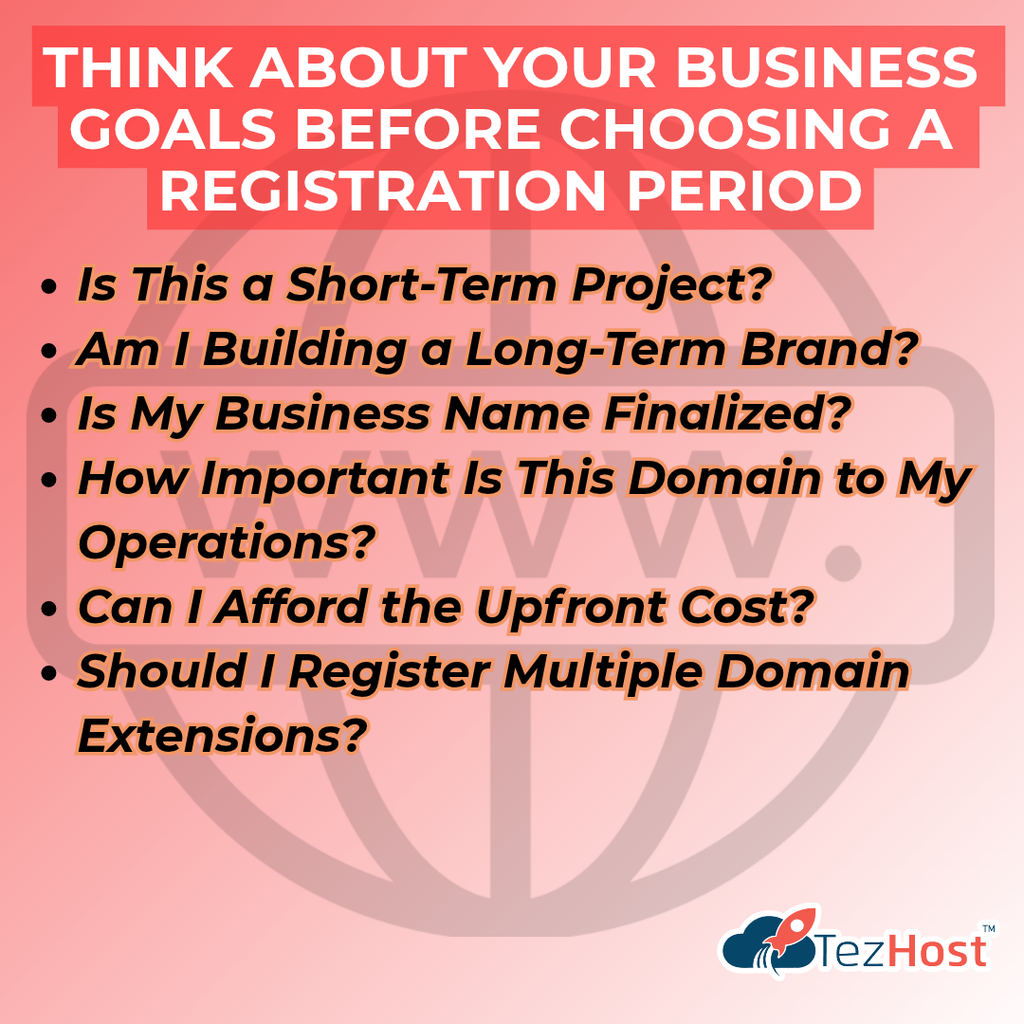
7. Think About Your Business Goals Before Choosing a Registration Period
Your domain renewal strategy should reflect your business plans rather than simply following the longest available registration option.
Before registering your domain, ask yourself a few questions.
Is This a Short-Term Project?
If you’re creating a temporary campaign website or testing a business idea, one year may be sufficient.
Am I Building a Long-Term Brand?
If the domain will represent your company for many years, a longer registration period may be more convenient.
Is My Business Name Finalized?
If you’re still considering different names, avoid committing to several years until you’re confident about your choice.
How Important Is This Domain to My Operations?
If your website, email, and customer services depend on the domain, renewal planning becomes especially important.
Can I Afford the Upfront Cost?
Longer registrations require more money upfront.
Choose a period that fits your budget.
Should I Register Multiple Domain Extensions?
Some businesses register additional extensions to support branding or reduce confusion.
For example, a business using a .com domain might also consider relevant country-specific extensions.
However, registering every possible variation is usually unnecessary.
Focus on domains that serve a clear business purpose.
If you’re choosing a domain for a new company, read our guide on How to Register a Domain Name for Business.
Your domain should support your business strategy, not complicate it.
Can You Transfer a Domain After Registering It for Several Years?
Yes. In many cases, you can transfer a domain to another registrar before its registration period ends, subject to transfer eligibility rules.
Your domain renewal strategy doesn’t have to lock you into the same registrar forever.
If you become dissatisfied with your current provider, you may be able to transfer your domain.
However, transfer rules vary by extension.
For many generic top-level domains, certain registration or transfer events can trigger a 60-day transfer restriction.
What Happens to Your Remaining Registration Period?
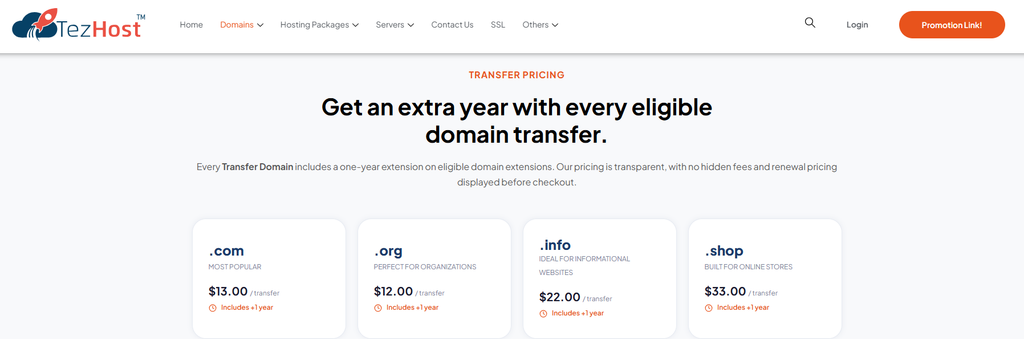
For many eligible generic top-level domains, a standard registrar transfer adds one year to the existing expiration date, subject to the registry’s maximum registration term and applicable exceptions.
The exact result depends on the domain extension and transfer circumstances.
Will Transferring a Domain Affect My Website?
Not necessarily.
A registrar transfer and a hosting migration are different processes.
Your website may remain online during a domain transfer if the relevant DNS settings continue working correctly.
However, you should verify your DNS configuration before initiating the transfer.
How Can You Transfer Your Domain to TezHost?
If you’re considering moving your domain registration, explore our guide on How to Transfer Your Domain.
You can also talk to a TezHost sales agent to discuss transfer requirements and available options.
Your domain registrar should support your needs, not make domain management unnecessarily difficult.
How Is TezHost Revolutionizing Domain Registration and Renewal?
At TezHost, we believe a good domain renewal strategy should be simple, practical, and aligned with your business goals.
Your domain is often the first connection between your business and your customers.
It’s part of your brand identity, your website address, and frequently your professional email system.
That’s why choosing and managing the right domain deserves attention.
1. Making Domain Registration Accessible
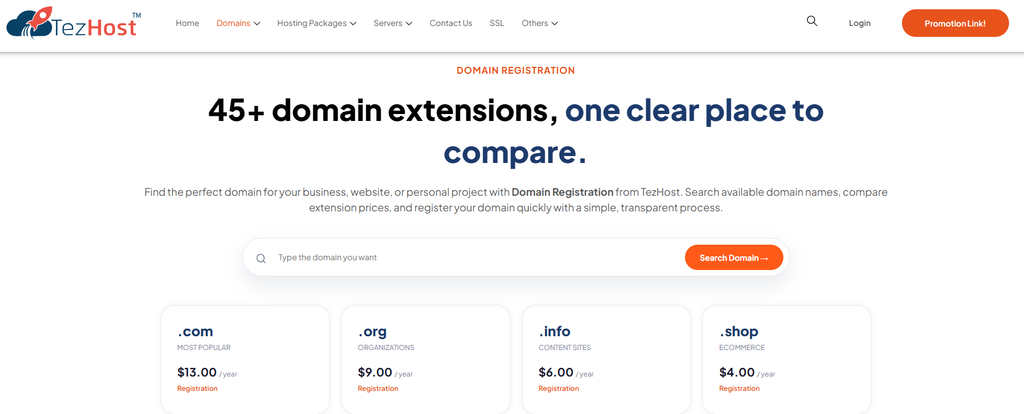
Whether you’re starting a blog, launching a startup, or expanding an established business, TezHost provides domain registration services for different online projects.
You can explore available domain extensions and registration options through our Domain Registration Services.
2. Helping Customers Make Informed Decisions
Not every business needs a ten-year domain registration.
Some customers benefit from flexibility.
Others prefer longer registration periods.
Our approach encourages customers to evaluate their plans, budgets, and long-term needs before making a decision.
3. Bringing Domain Registration and Hosting Together
Registering a domain is only the beginning.
Businesses also need hosting infrastructure to make their websites accessible online.
TezHost provides domain registration alongside web hosting services, allowing customers to explore essential services for building an online presence.
4. Supporting Domain Transfers
Already have a domain registered elsewhere?
TezHost provides information about transferring eligible domains.
Customers can review the transfer process and determine whether moving their registration is suitable.
5. Making It Easier to Get Started
For someone launching their first website, domain registration can feel confusing.
What extension should you choose?
How long should you register it?
What happens when it expires?
Our goal is to help customers understand these decisions before they purchase.
6. Providing Sales Guidance
Sometimes a quick conversation can save a lot of confusion.
If you’re unsure about registration terms, renewal pricing, or domain transfers, you can contact our team to discuss available services.
At TezHost, we want domain registration to be a practical first step toward building your online presence, not another complicated technical decision.
Ready to Secure Your Domain?
Your business name deserves a professional online identity.
Explore TezHost Domain Registration and check whether your preferred domain is available.
Not sure whether to register for one year or longer?
Talk directly to a TezHost sales agent and discuss your domain registration requirements.
Frequently Asked Questions About Domain Renewal Strategy
1. Is it better to register a domain for one year or ten years?
A one-year registration offers flexibility and a lower upfront cost. A ten-year registration can provide convenience for established brands. The best domain renewal strategy depends on your budget and long-term plans.
2. Does registering a domain for ten years improve SEO?
No. A ten-year registration is not an established direct Google ranking factor.
3. Is it cheaper to register a domain for multiple years?
Not always. Some registrars offer multi-year discounts, while others charge the same annual rate regardless of registration length.
4. Can I renew my domain before it expires?
Yes. Most registrars allow eligible domains to be renewed before expiration, subject to registry rules and maximum registration periods.
5. Can I register a domain for more than ten years?
Many common generic domain extensions have a maximum registration period of ten years. Other extensions may have different rules.
6. What happens if I forget to renew my domain?
Your domain may expire, potentially disrupting your website and email. Depending on the applicable rules, recovery may be possible for a limited period.
7. Does a longer domain registration protect my brand?
It reduces the frequency of renewal deadlines, but it doesn’t provide trademark protection or prevent every domain-related risk.
8. Can I change my domain registrar after registering for five years?
Yes, if the domain is eligible for transfer. Transfer rules and restrictions depend on the extension and registration history.
9. Should startups register domains for several years?
Startups can begin with one year if they’re testing an idea. Businesses confident in their brand may prefer a longer registration period.
10. Is domain auto-renewal safe?
Auto-renewal is a useful way to reduce accidental expiration risk, provided your payment information is current and the renewal process succeeds.
11. How do I choose the right domain registration length?
Consider your business goals, budget, expected project duration, renewal pricing, and ability to manage expiration reminders.
12. Where can I register or transfer my domain?
You can explore TezHost Domain Registration or contact our sales team for information about available registration and transfer options.
Conclusion: What’s the Smartest Domain Renewal Strategy?
The smartest domain renewal strategy isn’t about registering your domain for the longest possible period. It’s about choosing a registration length that matches your business needs.
If you’re testing a new idea, one year may be enough.
If you’re building a growing business, three or five years could provide greater convenience.
And if your domain represents an established brand you expect to maintain for many years, a longer registration period may make sense.
But here’s what matters most.
Don’t let your domain expire simply because you forgot to renew it.
Keep your contact information updated.
Understand renewal pricing.
Enable automatic renewal where appropriate.
And choose a domain registrar that meets your requirements.
Your domain name is more than a web address.
It’s where customers find you, where your brand lives online, and often where important business communications begin.
Ready to Secure Your Online Identity?
Your next big business idea deserves a domain name worth remembering!
Explore TezHost Domain Registration and find the right domain for your business.
Need help choosing a registration period or transferring an existing domain?
Talk directly to a TezHost sales agent to discuss your options.
Or register with TezHost today and take the first step toward building your online presence.
Choose your domain wisely. Plan your renewals carefully. Build your brand with confidence.