
A free email address may be enough when you’re communicating with friends, signing up for online services, or managing personal correspondence. But when customers contact your business, does an address ending in Gmail or Yahoo create the right impression?
Understanding domain based email benefits can help you decide whether a free account is sufficient or whether a custom business email is a better investment.
A domain-based address such as sales@yourbusiness.com connects your communication to your brand. It can support business credibility, consistent branding, and better control over company email accounts.
If you’re planning to establish your online presence, you can register with TezHost and explore the domain and hosting services available for your requirements.
1. What Is the Difference Between Free Email and Domain-Based Email?
The main difference is the domain used after the @ symbol.
A free email account typically uses a provider’s domain, such as:
yourbusiness@gmail.comyourname@yahoo.comyourcompany@outlook.com
A domain-based email uses a domain you own or control:
info@yourbusiness.comsales@yourbusiness.comsupport@yourbusiness.com
When comparing free email vs domain email, the difference goes beyond appearance. A custom domain gives your business a consistent email identity, while the email service determines how messages are hosted, stored, secured, and managed.
For example, you could register yourbusiness.com and connect it to a compatible email hosting provider. You would then configure the necessary DNS records, including MX records, to direct incoming email to the correct mail servers.
This is one of the practical domain based email benefits: your business can use its own identity rather than relying on a general-purpose email address.
2. Do Customers Trust a Domain-Based Business Email More?
Generally, a business email address that matches the company’s website looks more consistent and recognizable to customers.
Imagine receiving two quotations:
abccompany@gmail.comsales@abccompany.com
Both addresses can deliver legitimate business communication. However, the second clearly connects the sender to the company’s domain.
This is particularly useful for businesses that send quotations, invoices, proposals, customer support responses, and partnership communications.

One of the most visible domain based email benefits is brand consistency. Your website, email address, and other digital communication can use the same business identity.
However, a custom email address does not automatically prove that a business is legitimate. Customers should still verify the sender, website, and payment details before sharing sensitive information.
3. What Are the Main Domain Based Email Benefits for Businesses?
A professional email address can offer practical advantages as your business grows.

Consistent branding: Every email reinforces the same business name and domain.
Better business recognition: Customers can more easily associate your email address with your website and company.
Organized communication: You can create separate addresses for departments, such as sales@, billing@, and support@.
Greater administrative control: Depending on your email provider, administrators can create, disable, or manage employee mailboxes.
Easier staff transitions: When an employee leaves, an administrator can manage the account and redirect business communication according to company policy.
Long-term brand ownership: If you retain control of your domain, you can generally move your email service to another compatible provider without changing your public email address.
These domain based email benefits are useful for freelancers, agencies, ecommerce stores, consultants, and established companies.
4. Are Free Email Accounts Bad for Business?
No. Free email services are useful, accessible, and often provide excellent features.
For a freelancer starting out, a personal email account may be sufficient for initial conversations. A small project or side business may not need multiple mailboxes or centralized administration.
The issue is not that free email is inherently unprofessional or unreliable. The question is whether it meets your business requirements.
When evaluating free email vs domain email, consider:
- Does the address match your business identity?
- Do multiple employees need separate accounts?
- Do you need administrative control over company email?
- Will customers regularly receive invoices and proposals?
- Do you need consistent email addresses across departments?
If your business is growing, the domain based email benefits may justify the additional cost of registering a domain and choosing a suitable email service.
5. Does a Domain-Based Email Improve Email Security?
A custom domain does not automatically make email more secure. Security depends on the email provider, configuration, authentication, and account management.
However, using your own domain gives you control over important DNS-based email authentication settings, provided your email service supports them.
These include:
SPF (Sender Policy Framework): Identifies the mail servers authorized to send email for your domain.
DKIM (DomainKeys Identified Mail): Adds a cryptographic signature that receiving mail systems can verify.
DMARC (Domain-based Message Authentication, Reporting, and Conformance): Tells receiving systems how to handle messages that fail authentication checks and provides reporting.
You should also enable multi-factor authentication, use strong passwords, restrict account access, and maintain appropriate recovery procedures.
These technical controls add an important dimension to domain based email benefits, particularly for businesses that send customer communications or transactional messages.
When comparing professional email options, check whether the provider supports SPF, DKIM, DMARC, encryption, spam filtering, and administrative security controls.
6. Do You Need a Website to Create a Domain-Based Email?
No. You can use a custom domain for email without publishing a website.
You need a registered domain and an email hosting service that supports custom domains. Once you have both, you can configure the relevant DNS records.
For example, you could register yourbusiness.com and create info@yourbusiness.com even if the website is still under development.
You can explore TezHost domain registration to check available domain extensions and manage your domain.
If you already have a domain, you may also be able to use it with an external email provider. The important requirement is access to its DNS settings.
This flexibility is one of the useful domain based email benefits for startups that want to establish a recognizable business identity before launching their website.
7. Can You Forward Emails Instead of Paying for Multiple Mailboxes?
Yes, if your hosting environment supports email forwarding.
Email forwarding allows messages sent to one address to be redirected to another mailbox. For example, support@yourbusiness.com could forward incoming messages to an existing inbox.
However, forwarding is not necessarily the same as having a full email mailbox. It may not provide independent storage, outgoing email access, calendar features, or separate user credentials.
If you use cPanel, you can review how to set up email forwarding in cPanel.
For businesses comparing professional email options, forwarding can be useful for basic routing, while dedicated mailboxes are generally more suitable for employees who need to send and receive messages independently.
8. How Much Does a Professional Domain-Based Email Cost?
The cost depends on three main components:
- Domain registration: The annual cost of registering and renewing your chosen domain.
- Email hosting: The service that stores and manages your email messages.
- Additional features: Mailbox storage, security, backups, collaboration tools, and administration.
Some web hosting packages include email accounts, while dedicated business email platforms may charge per user or mailbox.

Before purchasing, check exactly what the package includes. Don’t assume that domain registration automatically includes email hosting or that every hosting plan provides unlimited mailboxes.
TezHost provides domain registration and different hosting solutions. You can register here or speak with a sales agent to discuss which service fits your requirements.
Understanding the costs helps you evaluate the actual domain based email benefits rather than choosing a service based only on its advertised price.
9. How Is TezHost Making Professional Email and Domain Services More Accessible?
At TezHost, we believe businesses should be able to build a consistent online identity without navigating unnecessarily complicated hosting decisions.
Our approach starts with helping customers establish their domain and select hosting solutions that suit their requirements.
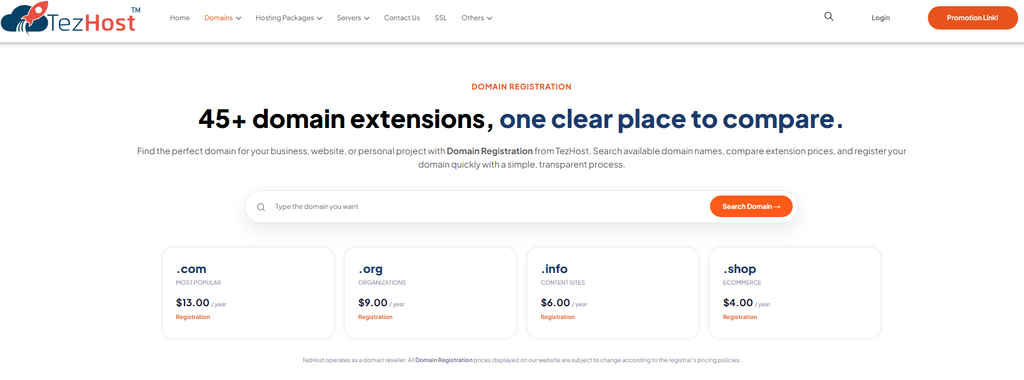
Here’s how TezHost supports that process:
- Domain registration: Explore different domain extensions and register a suitable business domain.
- Domain management: Manage DNS settings and other domain-related configurations.
- Hosting choices: Explore different hosting environments based on your website and application requirements.
- Control panel support: Use supported hosting environments such as cPanel, Plesk, and DirectAdmin to manage relevant hosting settings.
- Customer assistance: Contact our team for guidance when comparing available domain and hosting services.
Businesses exploring professional email options should review the email features included with their selected hosting plan before ordering. Mailbox availability, storage, and configuration options can vary.
You can explore the TezHost website, browse available domains, or talk to our sales team for assistance.
10. Which Email Option Should Your Business Choose?
The right choice depends on your current operations and future plans.
| Requirement | Suitable option |
|---|---|
| Personal communication | Free email |
| Early-stage side project | Free email may be sufficient |
| Freelancer building a personal brand | Domain-based email |
| Registered business communicating with customers | Domain-based email |
| Multiple employees and departments | Business email with administration |
| Advanced collaboration and security requirements | Dedicated business email platform |
When comparing free email vs domain email, don’t focus only on the monthly price. Consider branding, mailbox management, security, storage, and the ability to retain your email identity when changing providers.
For many businesses, the domain based email benefits become more valuable as customer communication and team requirements increase.
Frequently Asked Questions
Can I use Gmail with my own domain?
Yes. Certain Google Workspace plans allow businesses to use Gmail with a custom domain. You need to own the domain and configure the required DNS records.
Is a domain-based email free?
Not necessarily. Some web hosting packages include email accounts, but domain registration and dedicated email services may involve separate charges.
Can I use a free email address for my registered company?
Yes. There is generally no technical requirement to use a custom domain for ordinary business communication. However, a domain-based address can create a more consistent business identity.
Does a domain-based email improve SEO?
No. Using a custom email address is not a direct Google ranking factor. Its main value is professional branding and business communication.
Can I keep my email address if I change hosting providers?
Usually, yes. If you retain control of your domain and your new email provider supports custom domains, you can update your DNS records and migrate your mailboxes.
Is email forwarding the same as email hosting?
No. Forwarding redirects incoming messages to another address. Email hosting provides mailboxes and the infrastructure required to store, send, and receive messages.
Conclusion: Is a Domain-Based Email Worth It?
A free email account can work perfectly well for personal use and businesses in their earliest stages. But as your company develops, your email address becomes part of how customers recognize and communicate with your brand.
The domain based email benefits include consistent branding, better business recognition, organized communication, and greater control over company email identities.
You don’t necessarily need an expensive email platform. Start with a domain that represents your business, compare suitable email services, and choose a package that meets your actual requirements.
Whether you’re a freelancer, startup, agency, or established company, professional communication starts with choosing the right tools.
Ready to establish your business identity online?
Register your domain with TezHost, explore TezHost domain services, or talk to a sales agent to discuss your requirements.