
What happens if domain expires and you forget to renew it? Your website may stop working, business emails can become inaccessible, and you could eventually lose control of your domain name.
For businesses, a domain is more than a web address. It represents your brand, supports customer communication, and connects visitors to your products and services. Letting an unrenewed domain name expire can therefore create problems that go far beyond a temporary website outage.
The good news is that domain expiration is often recoverable if you act quickly. However, waiting too long can make recovery more complicated and expensive.
If you’re planning to register a new domain, register with TezHost and explore available domain extensions. Already have a domain and need guidance? Talk to a TezHost sales agent.
Let’s look at the seven major consequences of domain expiration and what you can do to avoid them.
1. Your Website May Stop Working
The first thing that can happen when a domain expires is that visitors may no longer be able to access your website.
Your website files might still be safely stored on your hosting server, but the domain connects visitors to those files through DNS (Domain Name System).
When a domain expires, its DNS services may be suspended or its records may stop resolving. Visitors could see a domain parking page, an expiration notice, or a browser error instead of your website.

For an online business, even a short interruption can mean:
- Lost sales and enquiries.
- Interrupted customer journeys.
- Failed website integrations.
- Reduced customer confidence.
What happens if domain expires while your hosting account is still active? Your hosting may continue running, but visitors might not be able to reach the website through its usual domain address.
If your website is business-critical, contact your domain provider immediately and check the renewal status.
2. Your Business Emails May Stop Working
A domain doesn’t only power your website. It also supports professional email addresses such as sales@yourcompany.com and support@yourcompany.com.
These addresses depend on DNS records, particularly MX records, to direct incoming email to the correct mail servers.

When domain expiration affects DNS resolution, your email services may become unavailable. This can interrupt:
- Customer enquiries and support requests.
- Password reset and verification emails.
- Sales communication and quotations.
- Internal business correspondence.
- Automated notifications from your website.
The exact impact depends on the registrar’s expiration process, DNS configuration, and mail provider.
An unrenewed domain name can therefore disrupt communication even if your email hosting subscription has not expired.
If your business depends on domain-based email, make domain renewal part of your IT operations checklist.
3. You May Have to Pay Additional Redemption Fees
One of the most frustrating domain expiration consequences is the possibility of paying more than the standard renewal price.
After expiration, a domain may pass through different lifecycle stages. Depending on the extension and registrar policy, you may have an initial renewal or auto-renew grace period, followed by a redemption period.

During redemption, restoring the domain can involve an additional fee on top of the normal renewal charge.
For example, TezHost’s published domain pricing currently lists a 30-day grace period and a 30-day redemption period for several common extensions. Its listed .com redemption fee is $87, in addition to the applicable renewal charge. Prices and policies can change, so check the current pricing before proceeding.
This is why what happens if domain expires is also a financial concern. A missed renewal deadline can turn a routine payment into a much more expensive recovery process.
For a better understanding of registration periods, renewal reminders, and long-term planning, read our guide to Domain Renewal Strategy.
Need help checking your domain’s renewal options? Speak with TezHost.
4. You Could Lose Your Domain Name Permanently
Can someone else register your domain after it expires?
Yes. Once a domain completes its expiration and deletion process, it may become available for registration by someone else.
This is one of the most serious domain expiration consequences, especially if your domain represents an established business or recognizable brand.
The usual lifecycle for many generic domain extensions can include:
| Stage | What it means |
|---|---|
| Expiration | The registration reaches its expiry date. |
| Grace period | The registrar may allow renewal under its applicable policy. |
| Redemption period | The domain may be recoverable, often with an additional fee. |
| Pending delete | The domain is awaiting deletion and generally cannot be restored by the previous registrant. |
| Available | The domain may be released for registration by someone else. |
The exact timeline is not identical for every domain. ICANN explains that a typical deleted generic top-level domain may enter a 30-day Redemption Grace Period, followed by a five-day Pending Delete period. Registrar and registry policies, as well as domain extensions, can affect the process.
Once released, another person or business may register the name. You might then have to negotiate a purchase, pursue a legal route where applicable, or choose a completely different domain.
For a business that has spent years building recognition around one web address, that can be a costly setback.
5. Your Brand Reputation and Customer Trust May Suffer
A domain name is often the first point of contact between a business and its customers.
Imagine a customer searching for your company, clicking your website, and finding an expired-domain notice or an unrelated page. They may assume your business has closed or is no longer operating.

If someone else registers your expired domain, the risk can become more serious. They could use the address for unrelated content, misleading pages, or attempts to impersonate your brand.
This is particularly concerning when the domain has previously been used for:
- Online shopping and customer accounts.
- Business email communication.
- Marketing campaigns.
- Customer support portals.
- Company login pages.
What happens if domain expires after years of brand building? You risk losing an important part of your online identity, not just your website address.
Protecting your domain is therefore a business continuity and brand protection decision.
6. Your SEO and Organic Traffic Can Be Affected
A domain expiration event can also create SEO problems.
Search engines need to access your website to crawl pages, understand content, and maintain their search listings. If the domain becomes inaccessible, search engine crawlers may encounter errors.

A prolonged outage can affect:
- Organic search visibility.
- Important landing pages.
- Backlinks pointing to your domain.
- Referral traffic.
- User experience and conversions.
A short interruption does not automatically erase your search rankings. However, an extended outage or loss of the domain can create significant recovery work.
If another person acquires the domain, the situation becomes even more complicated. Your old URLs may no longer lead to your business, and the new registrant may control the domain’s content and DNS.
An unrenewed domain name can therefore put years of SEO investment at risk.
The best approach is prevention: renew before expiration, maintain accurate contact details, and monitor your domain portfolio regularly.
7. Recovering Your Domain May Become Difficult
What should you do if your domain has already expired?
The first step is to contact your current registrar or domain provider. Check whether the domain is still within its renewal or redemption period and ask about the total recovery cost.

If the domain is recoverable, complete the required payment and restoration process as soon as possible.
However, if it has entered Pending Delete, you may have to wait until it is released. After that, there is no guarantee you will be able to register it again.
The consequences of an expired domain can be especially difficult when:
- The original account email is no longer accessible.
- The domain was registered by a former employee or agency.
- Payment details have expired.
- The domain is tied to an old hosting account.
- The domain has already been acquired by someone else.
Keep your registrar login details, billing information, and domain ownership records secure. If your domain is managed by a third party, make sure your business retains access and control.
For assistance with domain registration or management, contact the TezHost team.
How to Prevent Domain Expiration
Avoiding domain expiration is much easier than recovering a lost domain. A few practical steps can protect your website and business identity.

1. Enable automatic renewal
Where available, enable auto-renewal and make sure your payment method is valid. Do not rely on automatic renewal alone; check that the payment actually succeeds.
2. Keep your contact details updated
Your registrar sends important renewal notifications to the registered email address. An outdated email address can mean missing critical reminders.
3. Renew before the expiration date
Don’t wait until the last day. Renew early to avoid payment delays, billing issues, or unexpected account access problems.
4. Register for multiple years where appropriate
Longer registration periods can reduce how frequently you need to renew. Choose a term that suits your business plans and budget.
5. Maintain a domain inventory
Businesses managing multiple domains should maintain a record of domain names, expiration dates, registrars, account owners, and renewal status.
6. Protect access to your registrar account
Use strong passwords and multi-factor authentication where supported. Limit account access to authorized team members.
For more practical advice, read TezHost’s Domain Renewal Strategy: 7 Powerful Tips.
How TezHost Is Making Domain Management Easier
Managing domains should not become an administrative headache. TezHost aims to make domain registration and management more straightforward by bringing essential domain services and support together.
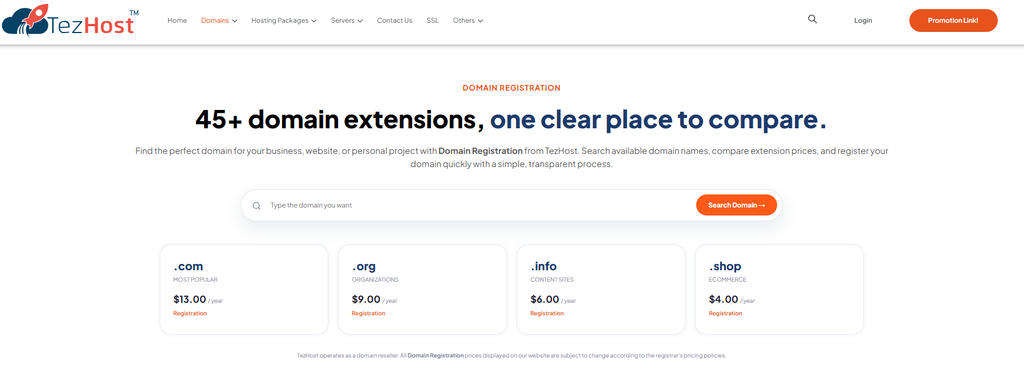
Through its domain registration services, customers can explore 45+ domain extensions and access useful management features, including:
- DNS management: Configure A, CNAME, and MX records.
- Domain privacy protection: Help protect personal contact details in public registration records where supported.
- Domain transfers: Move eligible domains to TezHost.
- Cloudflare integration: Access performance and security-related features.
- Domain management tools: Manage DNS settings, contact details, and renewal options.
- Customer support: Get assistance with domain registration and management.
TezHost also provides renewal guidance through customer communication channels, including email and calls. Customers should still keep their own renewal reminders and verify that payments have been completed.
Whether you’re registering a new domain or managing an existing one, explore TezHost and its domain services.
Want help finding or managing a domain? Talk to a TezHost sales agent.
Frequently Asked Questions
What happens if domain expires but hosting is still active?
Your hosting account may remain active, but your website may become inaccessible because the domain is no longer resolving correctly. Renewing the domain can restore access, depending on its lifecycle status and DNS configuration.
How long after expiration can I renew my domain?
It depends on the domain extension, registry, and registrar. Some domains have a grace period followed by a redemption period. Check your provider’s policy rather than assuming every domain has the same recovery window.
Can I lose my domain permanently if I don’t renew it?
Yes. If the domain passes through the applicable expiration, redemption, and deletion stages, it may be released for public registration. Someone else could register it.
Will my emails be deleted if my domain expires?
Not necessarily. Your mailbox data may remain with your email provider, but email delivery can be interrupted if the domain’s DNS or MX records stop working. Contact your email provider before making changes.
Does domain expiration affect Google rankings?
It can. If search engines cannot access your website for an extended period, your organic visibility may suffer. A short interruption does not automatically remove all rankings, but prolonged downtime creates SEO risks.
Can I renew a domain after the redemption period?
Usually, once a domain has moved into Pending Delete, the previous registrant cannot renew or restore it through the normal process. You may need to wait for release, but another person could register it first.
How can I check when my domain expires?
Log in to your domain provider’s client area and review the domain management or billing section. You can also use an ICANN lookup service for many generic domain extensions to check registration information.
Conclusion: Don’t Let a Missed Renewal Cost You Your Online Identity
So, what happens if domain expires? Your website and emails may stop working, recovery costs may increase, your SEO efforts can be affected, and you could eventually lose the domain to someone else.
A domain is a long-term digital asset. Protecting it requires more than registering it once. Keep your contact information updated, enable automatic renewal where possible, monitor expiration dates, and renew before the deadline.
If you’re looking for a domain for your next website or business, register with TezHost and explore available extensions.
Already have questions about domain registration or renewal? Talk to our sales team.
Protect your domain today. Don’t wait until it’s too late.