
Managing multiple domains is easier when you have a clear registration and management strategy. Whether you’re protecting your business name, launching different websites, managing client projects, or expanding into new markets, knowing how to register multiple domains efficiently can save time and help protect your online identity.
A domain portfolio can include your primary business domain, alternative extensions, country-specific domains, campaign URLs, product names, and domains for future projects. However, buying several domains without a plan can create unnecessary renewal expenses, security risks, and administrative work.
The key is to choose the right domain names, register them through a dependable provider, and keep everything organized.
If you’re planning to secure your domain portfolio, you can register your domains with TezHost. You can also speak with a TezHost sales agent for assistance with domain options and registration.
In this guide, we’ll explain how bulk domain registration works, why businesses register multiple domains, and how to manage a growing domain portfolio more efficiently in 2027.
What Is Bulk Domain Registration?
Bulk domain registration is the process of registering several domain names, often for the same business, individual, or organization, instead of purchasing them as unrelated, one-off registrations.

For example, a company might register:
yourbrand.comfor its main website.yourbrand.netto protect its brand identity.yourbrand.orgfor a community or organizational project.yourbrand.pkfor its Pakistani audience.yourbrand.co.ukfor its UK operations.- Alternative spellings or product-related domains for marketing campaigns.
The purpose is to build and manage a portfolio of relevant domain names.
When you register multiple domains, you should consider more than availability. Each domain has its own registration period, renewal requirements, DNS configuration, and potentially different pricing.
Bulk registration can make the process more convenient, but it does not mean every domain has identical terms or can be managed in exactly the same way.
Why Should You Register Multiple Domains?
Registering additional domains can help protect a brand, support expansion, and separate different online projects. It is particularly useful for businesses that operate across several markets or manage multiple products.
Here are some practical reasons to consider it.
1. Protect Your Brand Identity
Your primary domain is an important part of your business identity. If someone else registers a similar domain using another extension or a common variation of your brand name, customers may become confused.
For example, a business using example.com may also consider registering relevant alternatives such as example.net or a country-specific extension.
This does not guarantee complete protection against impersonation or trademark infringement, but it can reduce opportunities for confusion involving obvious domain variations.
When you register multiple domains, prioritize extensions and variations that are genuinely relevant to your business.
2. Expand Into International Markets
Businesses entering new countries may benefit from country-code top-level domains (ccTLDs).
For example:
.pkfor Pakistan..ukfor the United Kingdom..aefor the United Arab Emirates..safor Saudi Arabia.
A local domain can support market-specific branding and make a website feel more relevant to its intended audience.
However, some country-code extensions have eligibility requirements, documentation rules, or local presence conditions. Always check these requirements before purchasing.
3. Separate Different Products and Services
A business may offer several products, services, or digital platforms under one brand.
Instead of placing everything under a single website, it may choose separate domains for individual products, campaigns, or business divisions.
For example, a software company could maintain one domain for its main corporate website and separate domains for its SaaS products or customer portals.
This approach can make branding and website management more organized, provided each domain has a clear purpose.
4. Secure Domains for Future Projects
You do not need to launch a website immediately after registering a domain.
If you have a business idea, side project, product name, or campaign concept that you plan to develop later, securing the relevant domain early can prevent someone else from registering it first.
Our guide on why you should register a domain for your side project explains why securing a suitable name can be a useful early step.
How to Register Multiple Domains Efficiently
The registration process becomes easier when you prepare your domain list, check availability, and understand the requirements before placing orders.
Here are seven practical steps to follow when you register multiple domains.

1. Prepare a List of Domain Names
Start by creating a spreadsheet containing all the domains you want to register.
Include columns for:
- Desired domain name.
- Domain extension (TLD).
- Primary purpose.
- Target country or audience.
- Availability status.
- Estimated registration cost.
- Renewal date.
- Registration status.
Group your domains by priority. For example, mark your primary business domain and important brand variations as high priority, while optional campaign domains can be considered later.
A structured list helps prevent duplicate purchases and makes it easier to review your portfolio.
2. Check Domain Availability
Before placing an order, check whether each domain is available.
A domain name that looks suitable may already be registered, reserved, or offered at a premium price.
Use a domain search tool to check availability and compare alternative extensions. If your preferred .com domain is unavailable, consider whether another extension makes sense for your brand and audience.
TezHost offers a domain search facility and supports more than 45 domain extensions. You can explore available options through its domain registration service.
Remember that availability can change quickly. A search result is not a guarantee that a domain has been registered or reserved for you. Registration is subject to confirmation and the applicable registry and registrar processes.
3. Choose the Right Domain Extensions
Not every business needs to purchase every available extension.
Your selection should reflect your audience, brand protection requirements, and long-term plans.
Consider these common options:
| Extension | Common use |
|---|---|
.com | Commercial websites and international businesses |
.net | Technology, networking, and general-purpose websites |
.org | Organizations and community-focused projects |
.pk | Websites targeting Pakistan |
.co.uk | Businesses targeting the United Kingdom |
.io | Technology companies and software products |
Some extensions have restrictions, and their registration periods and renewal costs can differ.
When you register multiple domains, compare the full cost of each extension rather than selecting names based only on the first-year registration price.
4. Compare Registration and Renewal Costs
The initial registration price is only one part of domain ownership.
A domain may have a promotional first-year price but a higher renewal fee. Other extensions may require registration for two or more years at a time.
Before purchasing, review:
- Initial registration price.
- Renewal price.
- Transfer charges.
- Minimum registration period.
- Grace period after expiration.
- Redemption or restoration charges.
- Optional privacy and protection services.
For example, if you register ten domains, even a small difference in annual renewal costs can become significant over time.
Our domain registrar comparison explains why registration pricing, renewal fees, security, DNS management, and support should all be considered when choosing a provider.
5. Keep Domain Ownership and Contact Details Consistent
For business portfolios, use accurate and consistent registrant information wherever appropriate.
Maintain access to the registered email address and ensure that the contact information associated with each domain remains current.
For companies, it is also important to document who owns each domain legally and which team member is responsible for managing it.
Avoid registering business-critical domains through an employee’s personal email address without an appropriate ownership and access arrangement.
Depending on the extension, registration may require additional information or documentation. Make sure the details meet the applicable registry requirements.
6. Configure DNS and Domain Security
Registering a domain is only the first step. You must also configure its DNS records correctly.
Common DNS records include:
- A record: Points a domain or hostname to an IPv4 address.
- AAAA record: Points a hostname to an IPv6 address.
- CNAME record: Creates an alias pointing to another hostname.
- MX record: Directs email delivery to the relevant mail servers.
- TXT record: Stores verification and email authentication information.
- NS record: Identifies the authoritative nameservers for a domain.
If you manage multiple websites, incorrect DNS changes can affect website availability, email delivery, or third-party integrations.
Enable available security measures such as domain locking, account multi-factor authentication, strong passwords, and DNSSEC where supported.
Keep a record of important DNS configurations so that changes can be reviewed or restored when necessary.
7. Track Renewals and Review Your Portfolio
Every domain has an expiration date. Missing a renewal can result in service interruption, additional restoration fees, or eventually losing the domain.
Create a renewal calendar or use a domain management system that allows you to monitor expiration dates.
For a larger portfolio, track:
- Domain name and extension.
- Registration provider.
- Registration and expiration dates.
- Renewal price.
- Auto-renewal status.
- DNS and nameserver details.
- Business owner or responsible team member.
- Current purpose and usage.
Review your domain list at least quarterly. Remove unnecessary domains when appropriate, but check their business, legal, and technical importance before allowing them to expire.
A well-maintained portfolio makes it easier to register multiple domains without losing track of ownership, renewals, or security.
How to Manage Multiple Domains From One Place
Managing several domains through different providers can become difficult as your portfolio grows.
You may need to access separate accounts, monitor different billing dates, update DNS records in multiple dashboards, and contact different support teams.
Centralized management can simplify these tasks.
Look for a provider or management platform that offers:
- A consolidated domain list.
- Clear registration and renewal information.
- DNS management.
- Domain transfer assistance.
- Contact information management.
- Renewal reminders.
- Access controls and account security.
- Support for relevant domain extensions.
It is important to understand that centralized management does not necessarily mean all domains are registered with the same underlying registrar. A domain reseller may work with different registrar partners depending on the extension.
When you register multiple domains through a provider, confirm how the domains are processed, how they appear in your account, and how support and renewals are handled.
Common Mistakes to Avoid When Registering Multiple Domains
Buying several domains without a clear strategy can create unnecessary expenses and administrative problems.
Avoid these common mistakes:
1. Registering too many irrelevant extensions
You do not need every possible extension for your brand. Prioritize domains that protect your identity or serve a clear business purpose.
2. Ignoring renewal prices
A low introductory price may not represent the long-term cost. Always compare renewal fees before purchasing.
3. Using inconsistent ownership details
Unclear ownership can create problems when employees leave, businesses change hands, or access needs to be recovered.
4. Forgetting domain renewals
A missed renewal can disrupt your website, email, and other services connected to the domain.
5. Leaving DNS records undocumented
Without a record of important DNS configurations, troubleshooting and migration can become more difficult.
6. Assuming every domain extension has the same requirements
Different extensions can have different pricing, registration periods, eligibility rules, and transfer policies.
A sensible strategy helps you register multiple domains without turning your portfolio into an expensive collection of unused names.
How TezHost Is Improving the Domain Registration Experience
At TezHost, the approach to domain registration is built around making it easier for individuals, businesses, developers, and entrepreneurs to establish and manage their online presence.
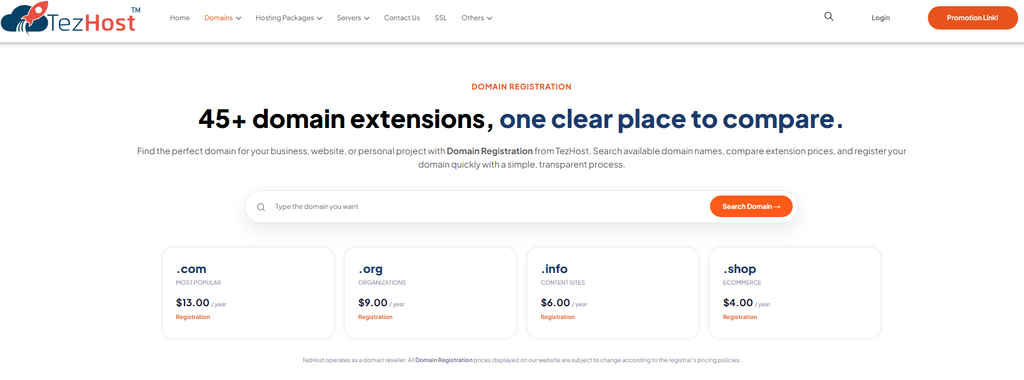
Instead of treating a domain as a standalone purchase, TezHost connects domain registration with hosting services and technical assistance.
Its domain service advertises:
- 45+ domain extensions: Options for different brands, industries, and geographical markets.
- Bulk domain registration options: Useful for customers building or expanding a domain portfolio.
- DNS management: Tools for managing records such as A, CNAME, and MX.
- Domain privacy protection: Available where supported by the relevant extension and registration partner.
- Domain transfer assistance: Support for customers moving eligible domains.
- Local payment options: Convenient payment methods for customers in Pakistan.
- Technical support: Assistance with domain availability, registration, and related hosting requirements.
TezHost operates as a domain reseller through registrar partners. This means the underlying registration is processed through those partners, and pricing, availability, and policies can vary by extension.
Once you have secured your domains, you can also connect them with TezHost hosting services, including shared hosting, VPS, cloud servers, and dedicated servers.
This provides a practical route for businesses that want to manage their domain and hosting requirements through one service provider.
If you are planning to register multiple domains for your business, visit the TezHost domain registration page to explore available extensions.
You can also register here or talk to a sales agent if you need help understanding your options.
Frequently Asked Questions About Bulk Domain Registration
1. Can I register multiple domains at once?
Yes. Many domain providers offer bulk registration options that help customers register several domain names. The exact ordering process may vary by provider and extension. For large domain lists, confirm the available process with the provider before placing your order.
2. Is bulk domain registration cheaper?
Not necessarily. Some providers may offer discounts or promotional pricing, but bulk registration does not automatically guarantee a lower price. Compare the registration, renewal, and transfer costs for every extension.
3. Can I register multiple domains under one account?
Yes. Domain providers commonly allow customers to manage multiple domain names through one account. However, each domain retains its own registration details, renewal date, and applicable terms.
4. Can I register different domain extensions for the same brand?
Yes. You can register different extensions for the same brand if they are available and you meet the relevant registration requirements. Businesses often consider .com, .net, and relevant country-code extensions to protect their online identity.
5. Does registering multiple domains improve SEO?
Registering additional domains does not automatically improve search rankings. Search engines evaluate the content, relevance, technical quality, and authority of websites.
If you operate several domains with similar content, you should avoid creating duplicate or low-value websites simply to target more keywords. Use additional domains for distinct purposes, or configure appropriate redirects when they are intended to point to one primary website.
6. Can I point multiple domains to one website?
Yes. Multiple domains can point to the same website through DNS configuration or redirects. For SEO and branding consistency, choose one primary domain and use appropriate permanent redirects for alternative domains where suitable.
7. What happens if I forget to renew a domain?
The domain may expire and stop resolving to your website or email services. Depending on the extension and registration provider, you may have a grace period or a redemption period during which recovery is possible, sometimes with additional fees. If the domain is not recovered, it may eventually become available for registration by someone else.
8. Can TezHost help me register multiple domains?
TezHost advertises bulk domain registration options and provides domain registration services through registrar partners. Customers can explore available extensions, DNS management, privacy protection where available, and technical assistance. For larger lists, contact the sales team to confirm the registration process and applicable pricing.
Conclusion: Build a Domain Portfolio That Supports Your Growth
Your domain portfolio is part of your business infrastructure. It can protect your brand, support international expansion, separate products, and secure names for future projects.
However, successful domain management requires more than purchasing several names. You need a clear registration strategy, accurate ownership details, secure DNS configurations, transparent renewal tracking, and a provider that can support your requirements.
When you register multiple domains, focus on the names that have genuine business value instead of collecting extensions without a purpose.
TezHost brings domain registration options, DNS management, hosting services, and technical assistance together to help customers manage their online presence.
Ready to secure your domain portfolio?
Explore domain registration with TezHost, register your domains here, or talk to our sales team for assistance.
Secure your domain names today and give your business room to grow.