Industries moving to cloud infrastructure are changing how they build, deliver, and protect digital services. From hospitals sharing medical information to retailers handling seasonal traffic, cloud servers are becoming an important part of modern IT strategy. The shift is not simply about replacing physical machines. It is about giving teams access to flexible computing, faster deployment, and infrastructure that can adapt as workloads change.
If your business is considering this transition, register with TezHost to explore available hosting services. You can also talk to a sales agent about your workload and server requirements.
The latest cloud adoption trends show that adoption is broad, but the reasons differ by sector. Understanding the cloud market by industry helps decision-makers identify where cloud servers add value, what risks to plan for, and whether a public, private, or hybrid model makes sense.
1. Why Are More Industries Moving to Cloud Servers?
For industries moving to cloud, the main driver is practical: businesses are moving workloads to cloud servers because they need flexible capacity without purchasing and maintaining every physical component themselves. Cloud infrastructure can provide virtual CPU, memory, storage, networking, and operating system control through a service arrangement.
The business case usually includes:
- Scalability: Increase or reduce resources as demand changes.
- Faster deployment: Launch development, testing, and production environments without waiting for hardware procurement.
- Remote access: Give distributed teams access to applications and systems through properly secured connections.
- Cost visibility: Match infrastructure resources to actual workload needs, while monitoring usage and transfer charges.
- Resilience options: Build backup, replication, and recovery arrangements across suitable environments.
The cloud adoption trends are supported by broader enterprise usage. The OECD reported that cloud computing was the most widely adopted digital technology among OECD firms in 2025, used by more than half of firms and over 80% of large firms. This does not mean every company has moved every workload. It shows how cloud services have become part of mainstream business technology.
2. Financial Services and Banking: Secure Digital Transactions at Scale
Among industries moving to cloud, financial services has a mature set of cloud and hybrid use cases. Financial institutions use cloud infrastructure for digital banking platforms, customer portals, analytics, fraud detection workflows, software development, and selected data processing. Mobile banking and online payments require systems that can handle fluctuating demand while maintaining strong security and availability.
The cloud market by industry includes financial services among the sectors with established cloud and hybrid infrastructure use. A 2025 Nasuni survey of 1,000 respondents found that 96% of financial services organizations surveyed supported cloud or hybrid cloud infrastructure.

That figure describes support for cloud or hybrid infrastructure, not the percentage of all banking workloads running in public cloud. Banks still assess data residency, regulatory obligations, encryption, identity controls, auditability, and third-party risk before moving sensitive systems.
Common cloud workloads include:
- Customer-facing websites and mobile application backends.
- Development and testing environments.
- Data analytics and reporting.
- Disaster recovery environments.
- Selected payment and integration services.
For financial organizations, industries moving to cloud infrastructure need governance as much as computing power. A well-designed architecture defines which data can move, who can access it, how activity is logged, and how services recover after disruption.
3. Healthcare and Life Sciences: Connected Care and Data Analysis
For industries moving to cloud, healthcare shows how digital access must be balanced with privacy. Hospitals, clinics, laboratories, and health technology companies use cloud services to support patient portals, appointment systems, telehealth, medical imaging workflows, research collaboration, and data analysis.
Cloud-based systems can help authorized healthcare teams access information across locations. They can also provide computing capacity for research workloads that may be difficult to run on limited local hardware.

The cloud adoption trends in healthcare are shaped by a careful balance between access and privacy. Patient records and diagnostic information are sensitive, so organizations must evaluate applicable health privacy laws, data residency rules, encryption, identity management, audit logs, and vendor agreements.
A Nasuni 2025 survey reported that 88% of healthcare and life sciences respondents supported cloud or hybrid infrastructure. Again, this measures organizational support, not full migration of every clinical system.
Typical use cases include:
- Patient portals and appointment booking.
- Telehealth applications.
- Research and medical data analysis.
- Secure collaboration between approved teams.
- Backup and disaster recovery.
Healthcare providers should not assume that placing data on a cloud server automatically makes a system compliant or secure. Configuration, access policies, staff processes, and provider responsibilities remain essential.
4. Retail and E-Commerce: Handling Traffic, Sales, and Customer Experience
Retail is one of the visible examples of industries moving to cloud because online demand can change quickly. Retailers face changing demand throughout the year. Holiday campaigns, flash sales, product launches, and promotional events can create traffic spikes that are difficult to predict.
Cloud servers can support ecommerce websites, inventory systems, product catalogues, customer portals, analytics, and integrations with payment or delivery services. Teams can adjust resources as traffic and application requirements change, subject to the architecture and provider’s scaling process.

The cloud market by industry is increasingly shaped by customer experience. Retail businesses want fast pages, reliable checkout processes, accurate inventory information, and consistent service across web and mobile channels.
Foundry’s 2025 cloud computing survey reported that 76% of retail respondents said their organization had accelerated cloud migration in the preceding year. This is a survey finding about migration momentum, not a claim that 76% of retail infrastructure had moved to cloud servers.
For retailers, industries moving to cloud often prioritize:
- Ecommerce hosting and checkout performance.
- Inventory and order management integrations.
- Customer relationship management.
- Marketing analytics and personalization.
- Seasonal capacity planning.
Retailers should also model network costs. Product images, video, downloads, APIs, and customer traffic can generate substantial data transfer. Read TezHost’s guide to cloud data transfer costs before estimating the total cost of a cloud workload.
5. Manufacturing and Logistics: Connecting Operations and Supply Chains
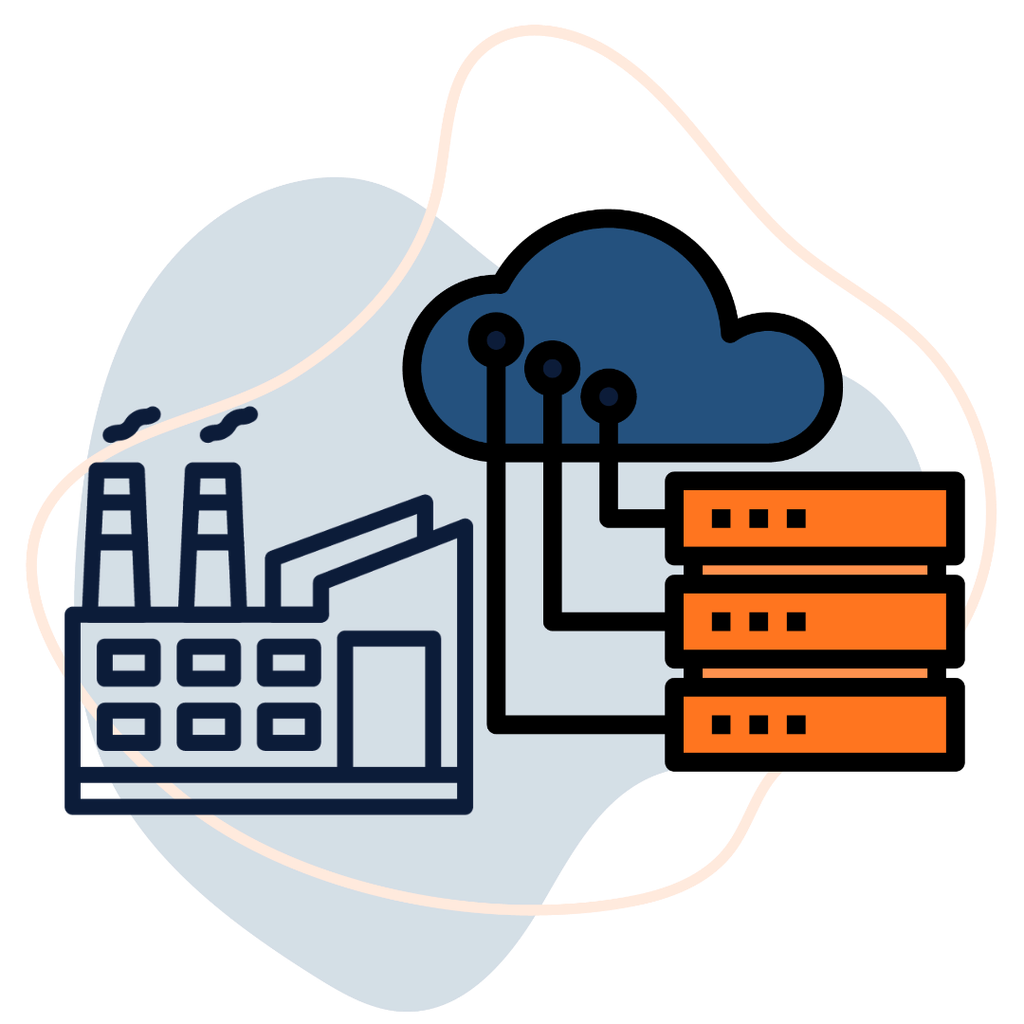
Industries moving to cloud also include manufacturers and logistics companies, which are adopting cloud infrastructure to connect production systems, suppliers, warehouses, vehicles, and business applications. Cloud platforms can support dashboards, analytics, enterprise resource planning integrations, inventory visibility, and data collected from connected equipment.
Some operational systems still need local processing because they depend on predictable latency, specialized hardware, or continuous operation at a factory site. In those cases, a hybrid model can be more practical than moving every workload to a remote environment.

A 2025 Nasuni survey found that 89% of manufacturing respondents supported cloud or hybrid cloud infrastructure. This points to broad infrastructure engagement, while actual deployment choices vary by company and production environment.
The cloud adoption trends in manufacturing often involve:
- Supply chain visibility and inventory systems.
- Production analytics and reporting.
- Predictive maintenance data processing.
- Supplier and partner portals.
- Development, testing, and backup environments.
For connected factories, network design matters. A cloud server may handle analytics and business applications, while time-sensitive machine control remains on-site. The architecture should account for latency, network interruptions, security segmentation, and operational safety.
6. Education and Research: Digital Learning and Collaboration
Education is another part of industries moving to cloud, with schools, universities, training providers, and research institutions using cloud services for learning management systems, student portals, online examinations, collaboration tools, research computing, and file storage.
Cloud hosting can help institutions serve learners across different locations and support periods of high activity, such as admissions, registration, and examination results. It can also make it easier for research teams to provision computing environments for specific projects.

However, education has varied budgets, legacy systems, and data protection responsibilities. Institutions should consider user access, backup retention, identity management, software licensing, and the security of student records.
In the wider cloud market by industry, education is adopting cloud services for both administration and teaching, but adoption levels and workloads differ between institutions. A small training centre may need a hosted learning platform, while a research university may need high-performance computing and complex data storage.
Practical use cases include:
- Learning management and virtual classrooms.
- Student information and admission systems.
- Research collaboration and data processing.
- Online assessment platforms.
- Institutional websites and portals.
The right cloud server depends on concurrent users, application design, database size, storage needs, and peak usage—not simply the number of enrolled students.
7. Media, Technology, and Professional Services: Building and Delivering Digital Products
Technology companies, software providers, media organizations, and professional service firms are among the most natural users of cloud infrastructure. They are established examples of industries moving to cloud because their products and teams are already digital. Their workloads often include SaaS platforms, web applications, APIs, content delivery workflows, development pipelines, analytics, and client portals.
Eurostat’s 2025 enterprise data showed that 82.92% of businesses in the information and communication sector purchased paid cloud computing services. Professional, scientific, and technical enterprises recorded 67.39%. These figures refer to paid cloud service use among enterprises in the EU, not exclusively cloud server hosting.
For software teams, cloud servers provide control over operating systems, runtime environments, databases, and deployment tools. Teams can build staging environments, test releases, host APIs, and run production applications with resources selected for the workload.
Media businesses may use cloud infrastructure for content management, publishing systems, video processing, collaboration, and storage. They should plan carefully for bandwidth, caching, storage growth, and data transfer charges.
The cloud adoption trends across these sectors are driven by shorter development cycles, distributed teams, digital product growth, and the need to deliver services across markets.
8. Energy, Government, and Other Sectors: Adoption With Specific Constraints
Industries moving to cloud also include energy companies, public agencies, utilities, construction businesses, and other sectors evaluating cloud services. Their requirements can be more complex because of remote sites, operational technology, legacy applications, public procurement rules, data residency, and critical service responsibilities.
Cloud workloads may include public information portals, document management, analytics, collaboration, customer service systems, and disaster recovery. Some organizations retain sensitive or operationally critical systems on-premises while moving less constrained applications to cloud infrastructure.

The cloud market by industry is not a race in which every sector must migrate at the same speed. A utility with remote industrial equipment has different latency and availability requirements from a professional services firm hosting a client portal.
A sensible approach starts with workload classification:
- Identify the business purpose and system owner.
- Classify data sensitivity and regulatory requirements.
- Measure performance, latency, and availability needs.
- Estimate compute, storage, and network costs.
- Decide whether public cloud, private cloud, on-premises, or hybrid infrastructure is appropriate.
9. Public, Private, or Hybrid Cloud: Which Model Fits Each Industry?
For industries moving to cloud, choosing the deployment model is as important as choosing the provider. There is no single deployment model for every organization.
Public cloud can suit workloads that benefit from provider-operated infrastructure and flexible service options. Private cloud may be considered when an organization needs greater control over its environment. Hybrid infrastructure combines on-premises resources with cloud services so workloads can be placed according to technical and business requirements.
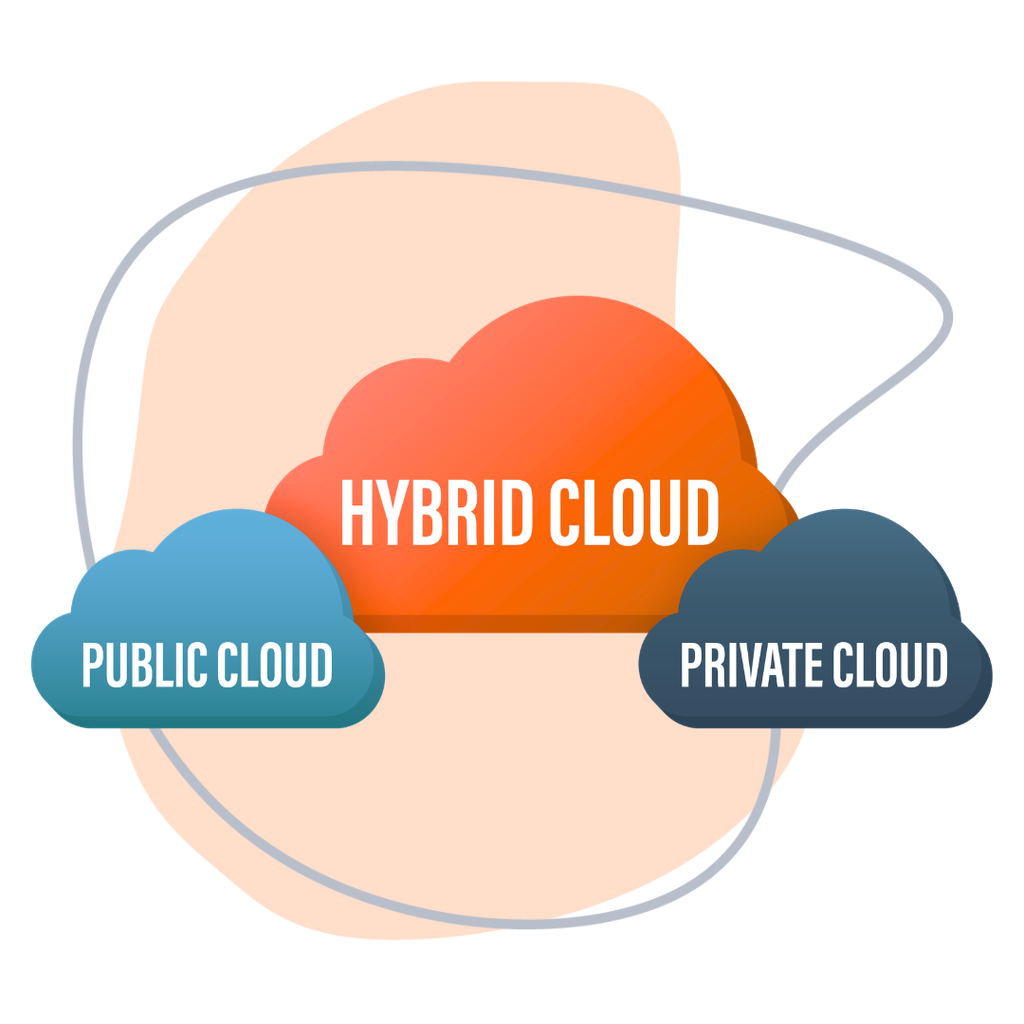
For example, a manufacturer may keep machine control systems on-site while hosting reporting dashboards in the cloud. A healthcare provider may use cloud services for patient portals while applying stricter controls to clinical data. A retailer may host its ecommerce platform in the cloud and connect it to existing inventory systems.
A hybrid approach can reduce the pressure to migrate everything at once. Read TezHost’s guide to hybrid infrastructure setup for examples of how on-premises systems and cloud resources can work together.
When industries moving to cloud evaluate hybrid architecture, they must plan network connectivity, identity management, encryption, monitoring, backup, and clear ownership across both environments. Hybrid does not automatically mean secure, cheaper, or highly available; those outcomes depend on implementation.
10. What Should Businesses Check Before Moving to Cloud Servers?
Before industries moving to cloud choose a cloud server, they should estimate the workload rather than selecting a plan based only on price.
Review these factors:
- CPU and RAM: Identify application and database resource requirements.
- Storage: Estimate operating system, application, database, log, and backup capacity.
- Bandwidth: Forecast traffic and data movement between users, services, and regions.
- Operating system: Confirm Linux or Windows compatibility and software dependencies.
- Access: Decide who needs root or administrative access and how credentials will be protected.
- Backup and recovery: Confirm whether backups are included, optional, or managed separately. Test restoration.
- Security: Configure firewalls, updates, SSH or remote access restrictions, monitoring, and least-privilege access.
- Scaling: Understand how upgrades work and whether downtime is required.
- Total cost: Include licensing, storage, backups, network transfer, administration, and support.
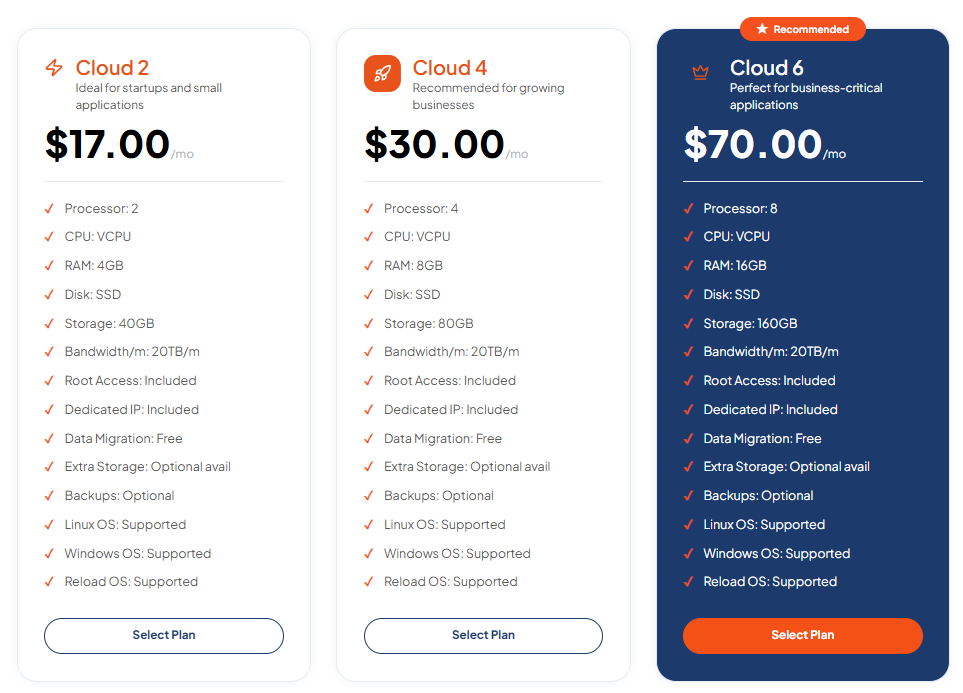
TezHost’s published Cloud Server plans start at $17 per month. The listed Cloud 2 plan includes 2 vCPU, 4GB RAM, 40GB storage, 20TB monthly bandwidth, root access, a dedicated IP, free data migration, and Linux or Windows support. The Cloud 4 plan is listed at $30 per month with 4 vCPU, 8GB RAM, and 80GB storage. Backups are listed as optional, so businesses should include their backup requirements in the final cost and recovery design.

These specifications are examples, not a universal recommendation. Actual sizing depends on application architecture, concurrent users, database activity, traffic patterns, and performance testing.
Have questions about selecting resources? Talk to a TezHost sales agent to discuss your requirements before choosing a plan.
How TezHost Is Supporting the Shift to Cloud Infrastructure
As more industries moving to cloud look for practical infrastructure options, TezHost focuses on making cloud server resources accessible to startups, developers, and growing businesses that need more control than basic shared hosting can provide.
Its published cloud server range uses AMD EPYC processors, DDR5 memory, and Gen4 NVMe SSD storage. Plans include root access, a dedicated IP, 20TB monthly bandwidth, free data migration, and Linux and Windows operating system support. Customers can compare configurations from the entry-level Cloud 2 plan to larger options for more demanding workloads.
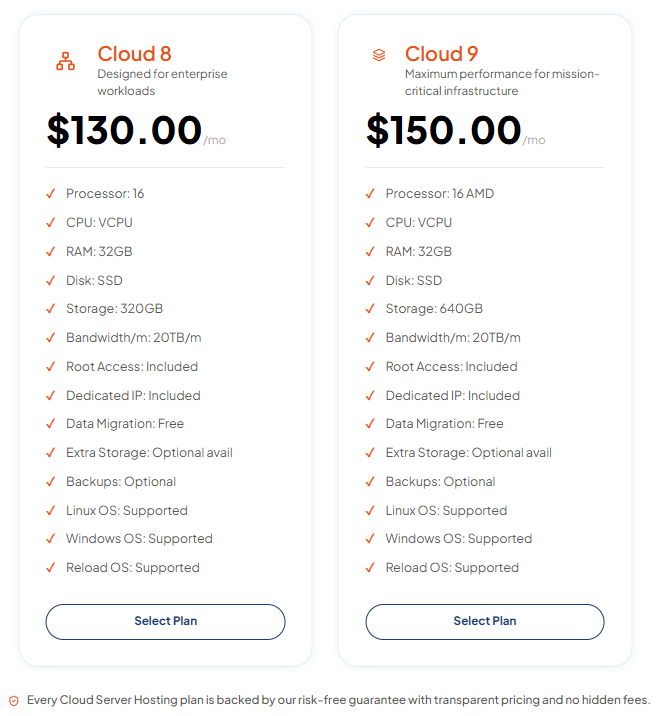
This approach gives businesses the flexibility to select resources according to their applications rather than automatically paying for an oversized environment. It also supports different use cases, including business websites, ecommerce platforms, development environments, and application hosting.
Cloud adoption trends show why flexibility matters, but selecting a server is only one part of a successful deployment. Businesses still need to configure security, monitor resource usage, plan backups, and understand data transfer costs.
Explore TezHost Cloud Servers or visit the TezHost website to review available services. If you need help assessing a workload, speak with our sales team.
Conclusion: Cloud Adoption Is About Choosing the Right Infrastructure
Industries moving to cloud servers include financial services, healthcare, retail, manufacturing, education, technology, media, government, and many others. But each sector is adopting cloud for its own reasons—from digital transactions and connected care to ecommerce performance, research, and supply chain visibility.
The strongest cloud adoption trends are not about moving everything simply because cloud is popular. They are about choosing the right workloads, deployment model, security controls, and cost structure.
Before making the move, assess your applications, data sensitivity, performance needs, bandwidth, backup strategy, and long-term operating costs. A carefully planned cloud or hybrid environment can give your business more flexibility without creating unnecessary complexity.
Ready to explore cloud infrastructure for your business? Register with TezHost, compare Cloud Server plans, or talk to a sales agent to discuss your requirements.
Frequently Asked Questions
Which industries are adopting cloud servers the fastest?
Technology, financial services, retail, and information and communication businesses are among the sectors showing strong cloud adoption. The pace varies by country, company size, regulation, and the type of workload being migrated.
Is hybrid cloud better for regulated industries?
It can be appropriate when organizations need to retain selected workloads on-premises while using cloud services for other systems. It is not automatically more compliant or secure; architecture and controls determine suitability.
What is the biggest cost businesses overlook when moving to cloud?
Data transfer, storage growth, backups, software licensing, and administration can add to the server price. Review the full pricing model and estimate traffic before migration.
How do I choose the right cloud server?
Start with measured CPU, RAM, storage, bandwidth, operating system, and application requirements. Include security, backups, recovery objectives, support, and expected growth in the decision.