Cloud migration checklist planning is essential before moving your website, applications, databases, or business infrastructure to the cloud. A successful migration starts with understanding your current infrastructure, calculating costs, evaluating security, choosing the right provider, and preparing for potential downtime.
Moving to the cloud can offer greater flexibility, easier infrastructure management, and opportunities to scale resources as your business grows.
However, cloud migration isn’t simply about transferring files from one server to another.
It involves making important decisions about performance, security, compatibility, cost, and business continuity.
The biggest mistake businesses make is migrating before understanding what their applications actually need.
Whether you’re running a small business website, managing an e-commerce store, or operating complex applications, asking the right questions can help you avoid unnecessary expenses and migration complications.
At TezHost, we help businesses explore hosting solutions that fit their technical requirements and growth plans.
Planning your move? Register with TezHost today and explore cloud hosting options for your business.
In this guide, we’ll cover nine essential questions before moving to the cloud, explain how to prepare for migration, and help you make a more informed infrastructure decision.
1. Why Am I Moving to the Cloud?
The first question in your cloud migration checklist should be: What business problem am I trying to solve?
Moving to the cloud should have a clear purpose.
Businesses commonly consider cloud migration to achieve:
- Greater infrastructure flexibility.
- Easier resource scaling.
- Reduced dependence on physical hardware.
- Improved application deployment processes.
- More flexible development environments.
- Better disaster recovery options.
- Access to specialized computing resources.
However, cloud migration doesn’t automatically improve performance or reduce expenses.
The benefits depend on your existing infrastructure, application requirements, and the cloud environment you choose.
What Should You Evaluate?
Before migrating, identify your current challenges.
Are you experiencing frequent resource limitations?
Does your website struggle during traffic spikes?
Are hardware maintenance costs increasing?
Do your developers need more control over their hosting environment?
Our recommendation: Define two or three measurable migration goals before selecting a cloud provider.
For example, your goals might include reducing deployment time, improving recovery capabilities, or supporting higher application demand.
This will help you evaluate whether the migration actually delivers business value.
2. How Much Will Cloud Migration Cost?
Your cloud migration checklist should include both the initial migration expenses and the ongoing cost of operating your cloud infrastructure.
Cloud hosting costs depend on several factors, including CPU, RAM, storage, bandwidth, software licensing, backups, and management requirements.
What Expenses Should You Consider?
| Expense | What It Includes |
|---|---|
| Compute Resources | CPU and RAM allocation |
| Storage | SSD/NVMe storage and additional volumes |
| Bandwidth | Data transfer and potential overage charges |
| Software Licensing | Operating systems and commercial applications |
| Security | Firewalls, monitoring, and protection tools |
| Backups | Backup storage and recovery services |
| Migration | Data transfer, testing, and technical work |
| Management | Server administration and maintenance |
For example, a small website may only require a modest cloud server.
A large application with extensive databases, high traffic, and advanced security requirements may need significantly more resources.
Is Cloud Hosting Cheaper Than Traditional Infrastructure?
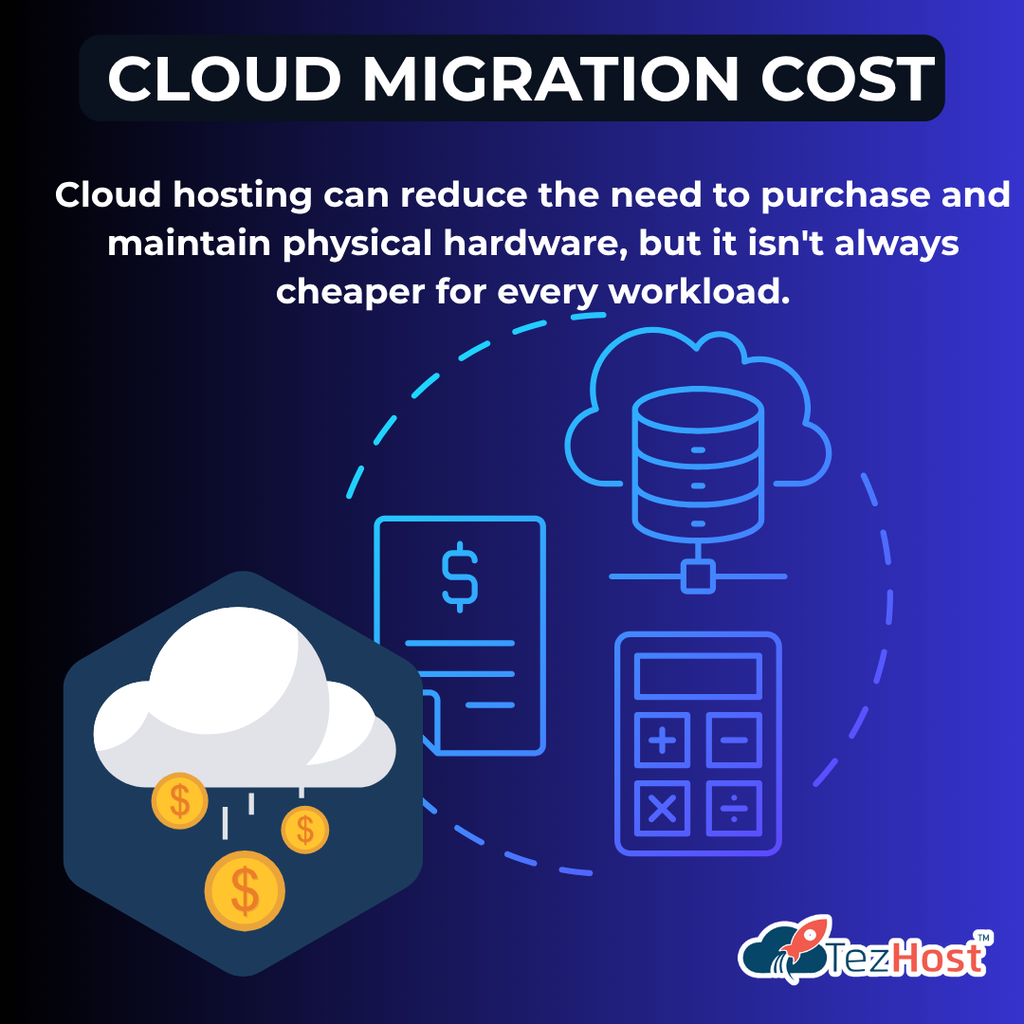
Cloud hosting can reduce the need to purchase and maintain physical hardware, but it isn’t always cheaper for every workload.
Businesses should compare total operating costs rather than advertised monthly prices.
Read our detailed guides:
Need help estimating your cloud hosting budget?
Talk to a TezHost sales agent to explore configurations suited to your requirements.
3. Which Cloud Hosting Provider Should I Choose?
Choosing a reliable provider is one of the most important decisions in your cloud migration checklist.
The right provider should offer infrastructure and services that match your applications, technical expertise, budget, and support requirements.
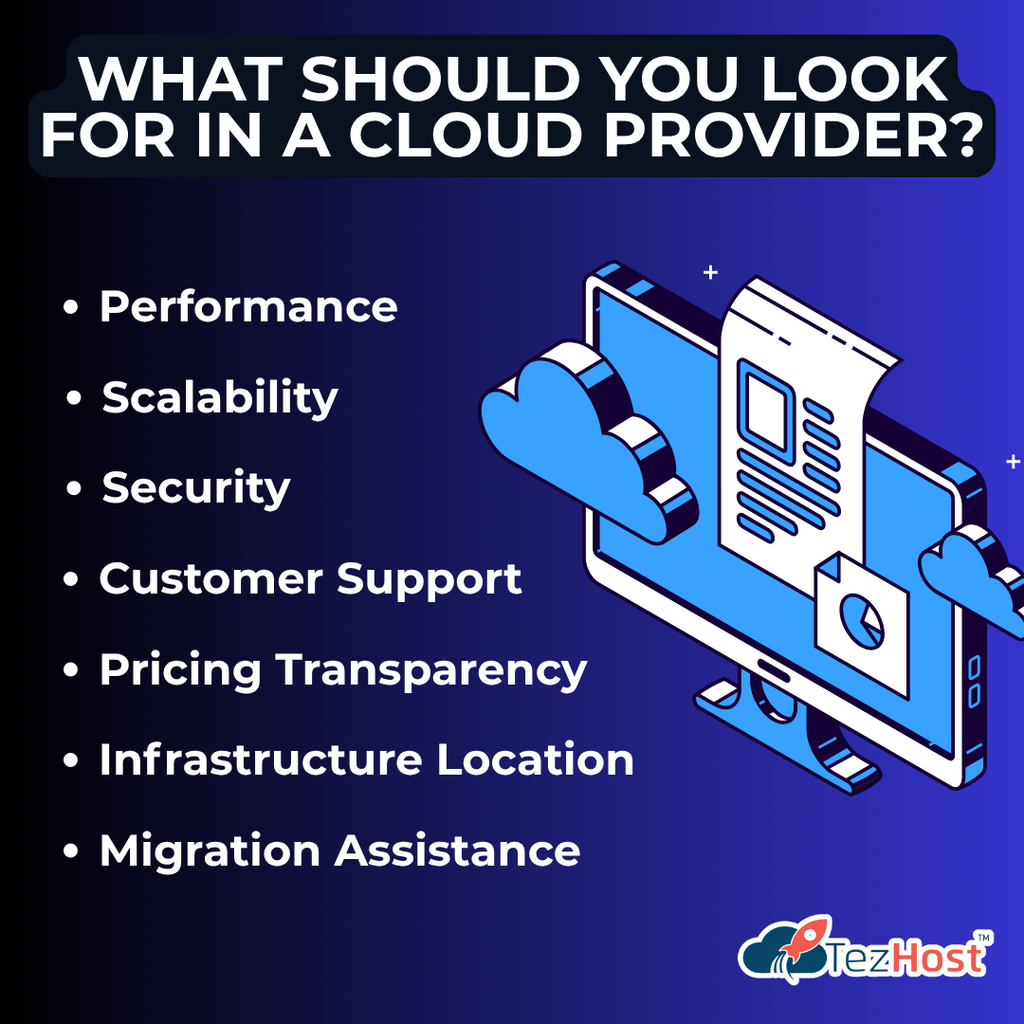
What Should You Look for in a Cloud Provider?
Consider these factors:
Performance
Evaluate available CPU, RAM, storage technology, and network connectivity.
Scalability
Determine whether you can increase or decrease resources as your requirements change.
Security
Review access controls, network protection, backup options, and available security features.
Customer Support
Understand which support channels are available and what technical assistance is included.
Pricing Transparency
Check monthly charges, software licensing, bandwidth allowances, and potential additional fees.
Infrastructure Location
Consider where your customers are located and whether the provider offers suitable server locations.
Migration Assistance
Ask whether the provider offers migration support and what the service covers.
For a broader comparison, explore our guide to 6 Top Cloud Providers to Find Your Cloud Solution.
How Can TezHost Help?
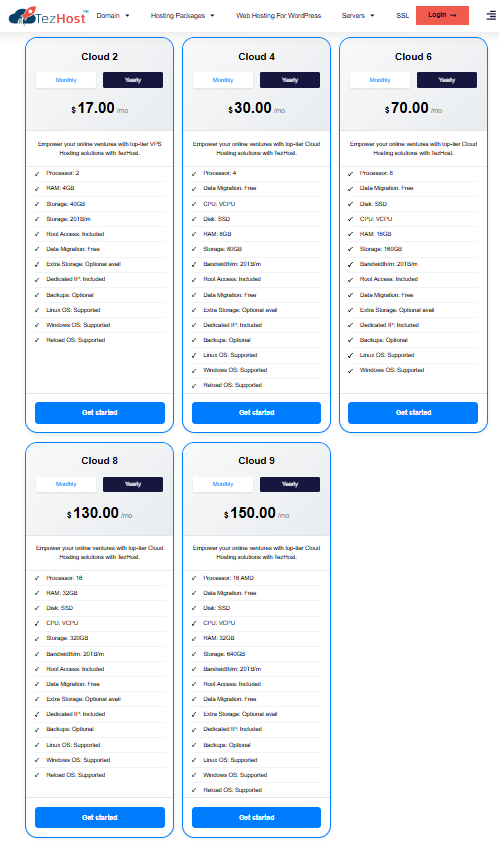
TezHost offers Cloud Server Hosting for businesses looking for flexible virtualized infrastructure.
You can also speak directly with our sales team to discuss suitable hosting options.
4. Are My Applications Ready for Cloud Migration?
Application compatibility is a critical part of your cloud migration checklist.
Not every website or application can be moved to a new environment without modifications.
Before migrating, evaluate your existing software, databases, dependencies, and server configurations.
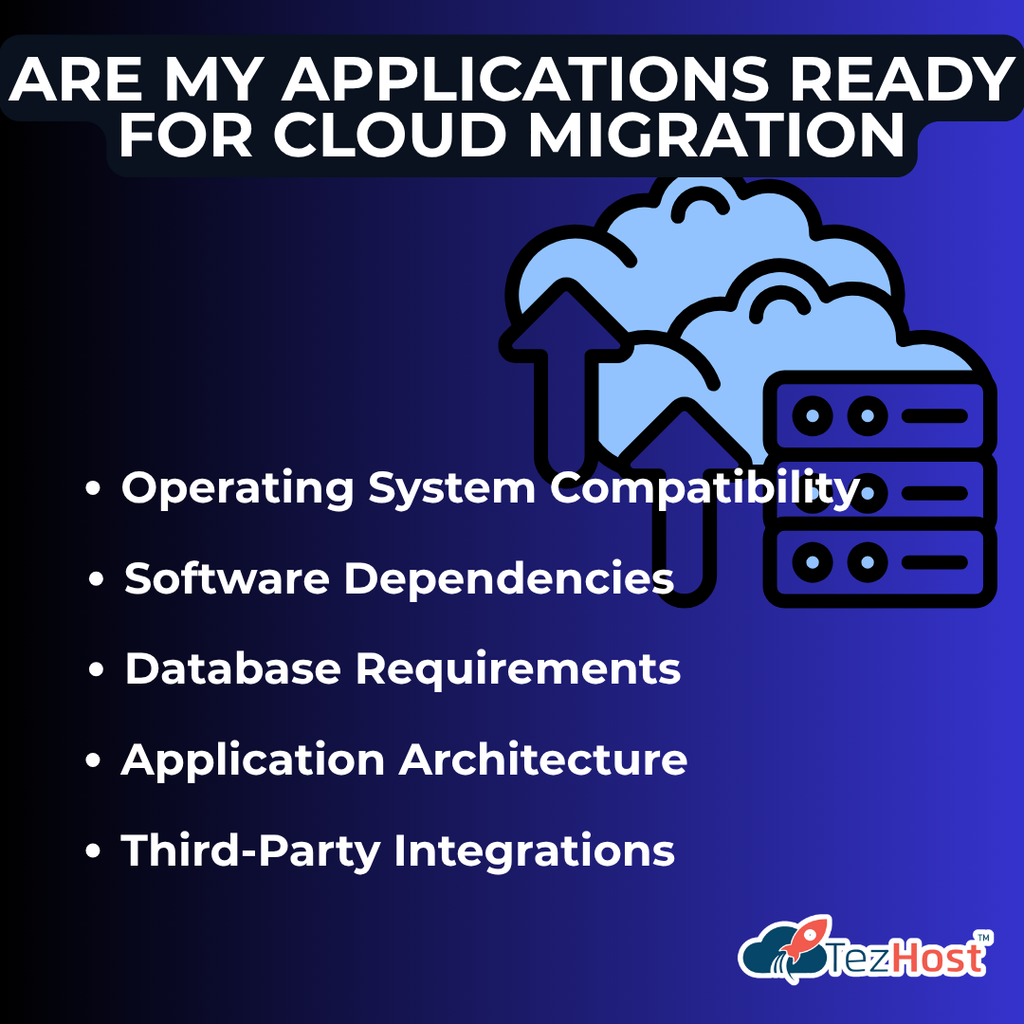
What Should You Check?
Operating System Compatibility
Confirm that your applications support the operating system available on the new server.
Software Dependencies
Identify required programming languages, frameworks, libraries, and application versions.
Database Requirements
Review database engines, versions, storage requirements, and connectivity.
Application Architecture
Determine whether your application depends on specific hardware, network configurations, or local services.
Third-Party Integrations
Check payment gateways, APIs, email services, and other external connections.
Should You Migrate Everything at Once?
Not necessarily.
For complex environments, migrating applications in stages can reduce risk.
Start with less critical workloads, validate their functionality, and then proceed with business-critical systems.
Our recommendation: Create an application inventory before migration, including software versions, dependencies, databases, and integration requirements.
5. How Will I Protect My Data During Migration?
Data protection should be a top priority in every cloud migration checklist.
A successful migration requires more than copying website files.
You must protect databases, application configurations, customer information, and other important business data.
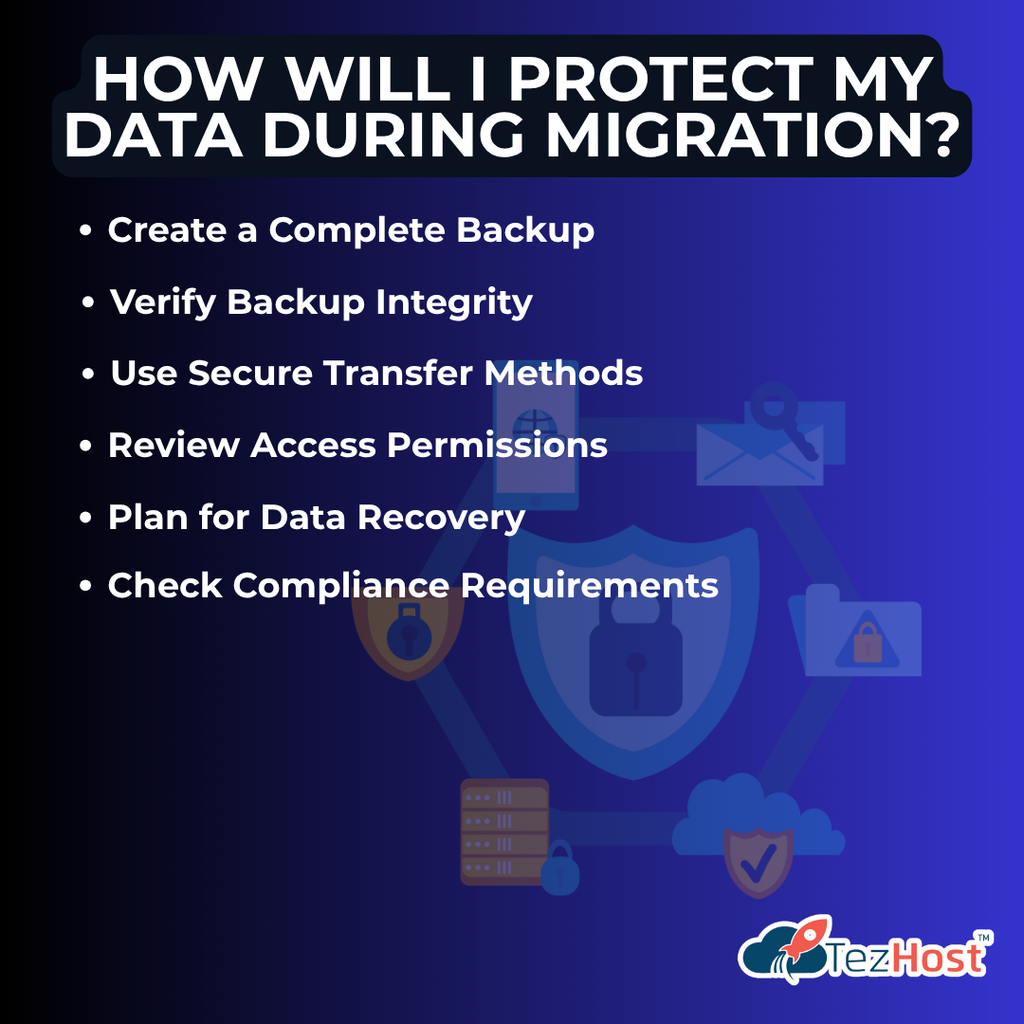
Essential Data Protection Steps
Create a Complete Backup
Back up website files, databases, application settings, and relevant configurations.
Verify Backup Integrity
Confirm that your backups can be restored successfully.
Use Secure Transfer Methods
Protect data during migration through appropriate encrypted transfer methods.
Review Access Permissions
Ensure only authorized personnel can access sensitive information.
Plan for Data Recovery
Prepare a recovery process in case migration fails.
Check Compliance Requirements
If your business processes regulated or sensitive information, confirm that the new environment meets applicable legal and contractual requirements.
Can Cloud Migration Cause Data Loss?
Yes. Data loss can occur if migration processes are poorly planned, backups are incomplete, or changes made during the migration are not synchronized correctly.
However, careful preparation, tested backups, and validation procedures can significantly reduce this risk.
Our recommendation: Never begin a production migration without a verified backup and a documented recovery plan.
6. How Much Downtime Should I Expect?
Your cloud migration checklist should include a realistic downtime assessment and a plan for maintaining business continuity.
Migration downtime depends on the size of your website, application architecture, database activity, and migration method.
Some migrations can be completed with minimal disruption.
Others may require a planned maintenance window.
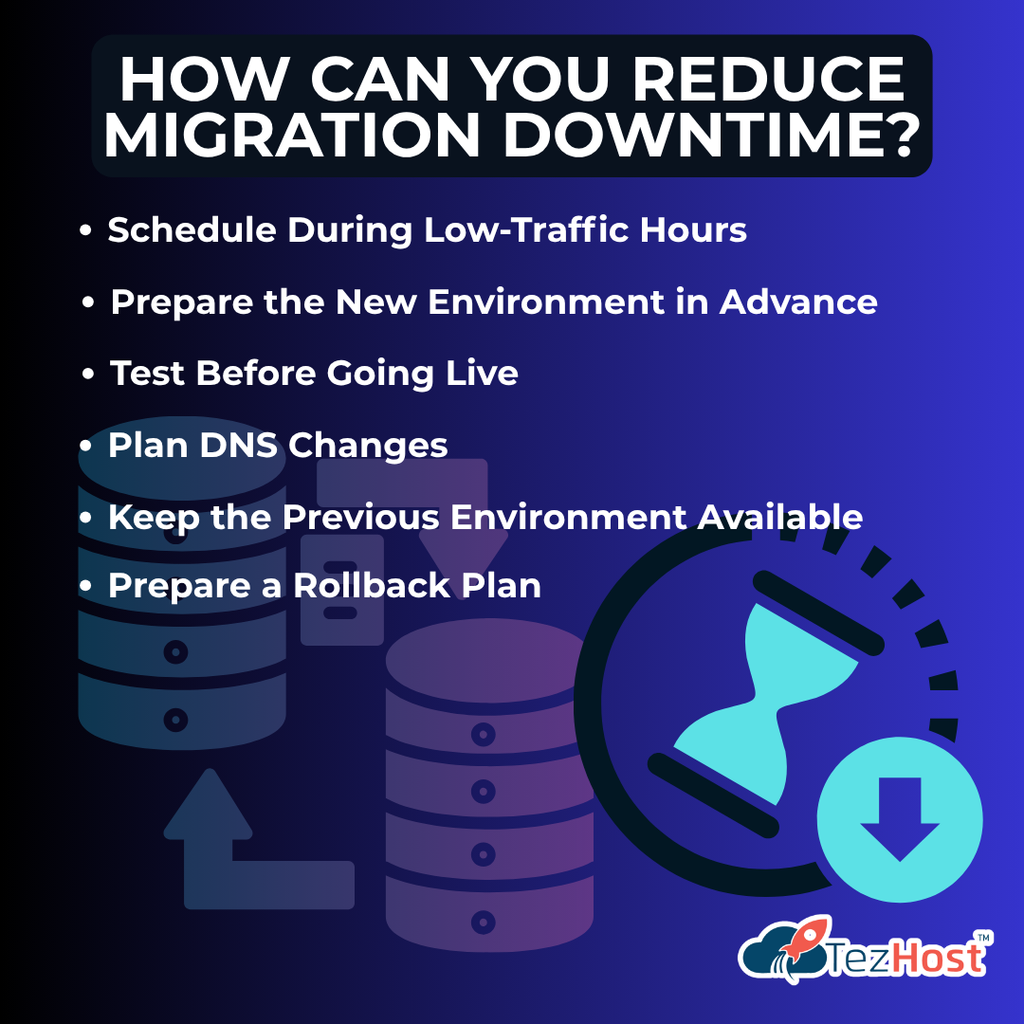
How Can You Reduce Migration Downtime?
1. Schedule During Low-Traffic Hours
Choose a migration window when fewer customers are likely to be affected.
2. Prepare the New Environment in Advance
Install required software and configure the destination server before switching production traffic.
3. Test Before Going Live
Verify website functionality, database connectivity, email services, and application performance.
4. Plan DNS Changes
Review DNS records and TTL settings before switching traffic.
5. Keep the Previous Environment Available
Maintain the original environment until the new deployment has been validated.
6. Prepare a Rollback Plan
Document how to restore service if problems occur.
Can You Migrate a Website Without Downtime?
Some websites can be migrated with little or no noticeable downtime through careful synchronization, testing, and traffic switching.
However, zero downtime cannot be guaranteed for every application.
For practical guidance, read our Guide to Transferring Your Website to a New Host.
Need help understanding your migration requirements?
Connect with a TezHost sales agent before starting your move.
7. What Security Measures Will I Need in the Cloud?
Security planning is an essential component of your cloud migration checklist.
Moving to the cloud changes how your infrastructure is managed, but it doesn’t eliminate your responsibility to protect applications and data.
Cloud security typically follows a shared responsibility model.
The provider manages certain infrastructure components, while customers remain responsible for aspects such as application security, user permissions, and software configuration.
The exact responsibilities depend on the service.
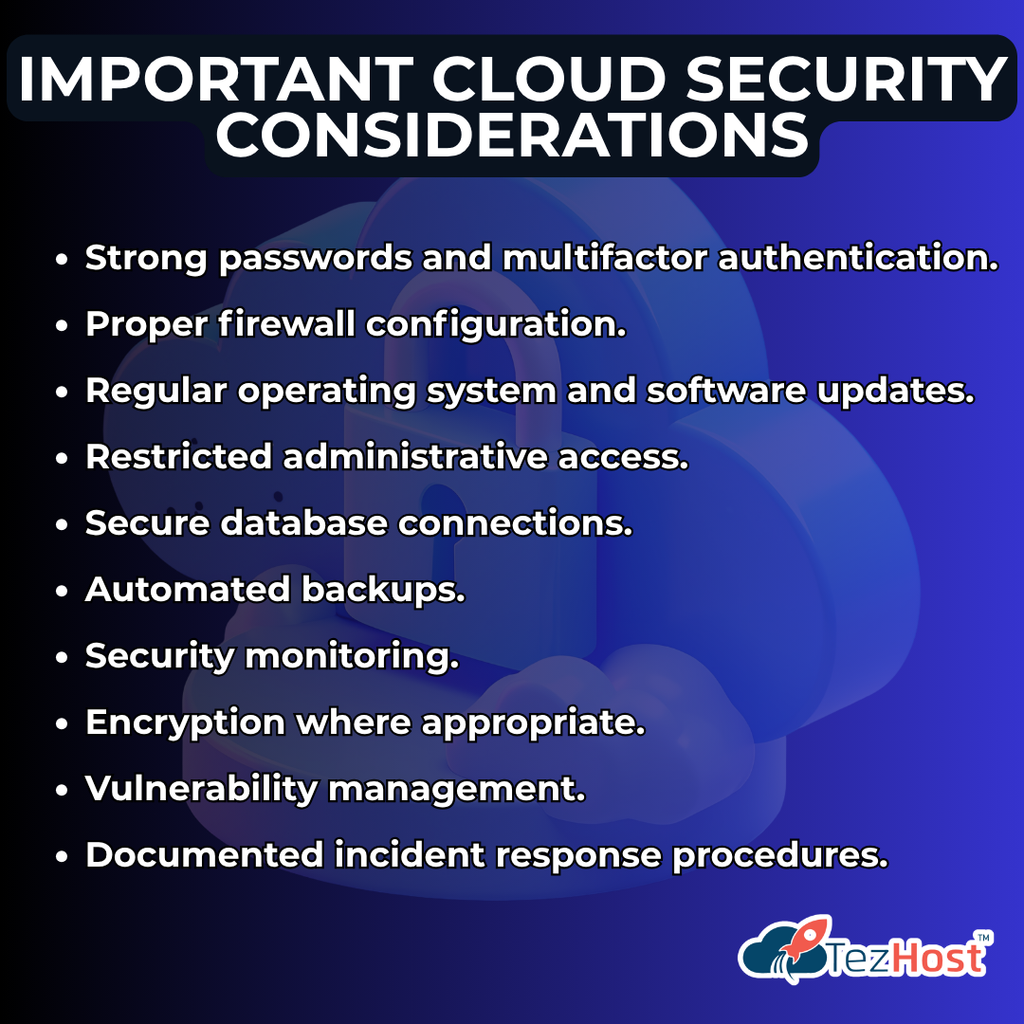
Important Cloud Security Considerations
- Strong passwords and multifactor authentication.
- Proper firewall configuration.
- Regular operating system and software updates.
- Restricted administrative access.
- Secure database connections.
- Automated backups.
- Security monitoring.
- Encryption where appropriate.
- Vulnerability management.
- Documented incident response procedures.
Is Cloud Hosting More Secure Than Traditional Hosting?
Cloud hosting can provide strong security capabilities, but security depends on infrastructure design, provider controls, and customer configuration.
A poorly configured cloud server can still be vulnerable.
Our recommendation: Review the provider’s security features and clearly establish which responsibilities belong to your business.
8. Will My Cloud Infrastructure Support Future Growth?
Scalability is another important consideration in your cloud migration checklist.
Your hosting environment should support your current workloads while providing a practical path for future growth.
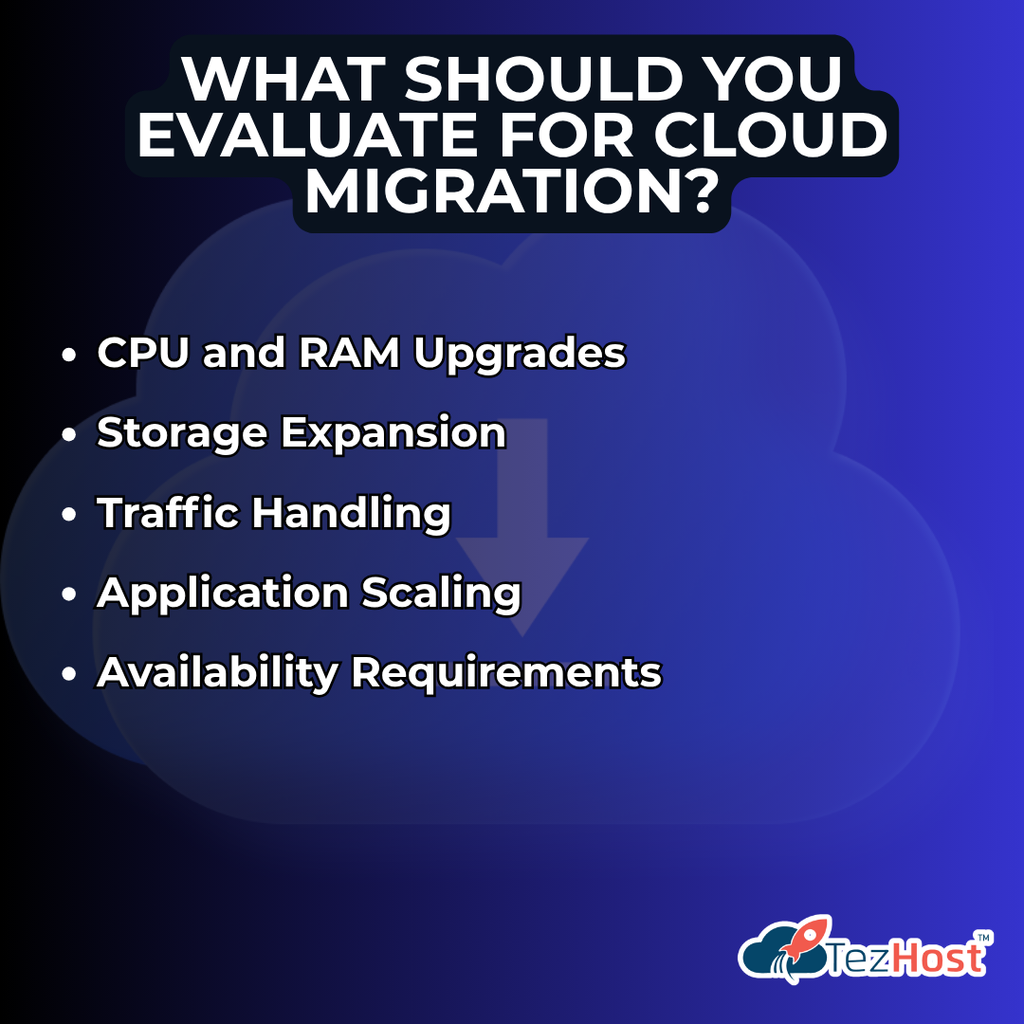
What Should You Evaluate?
CPU and RAM Upgrades
Can you increase computing resources when your application requires them?
Storage Expansion
Can you expand storage without complicated migrations?
Traffic Handling
Will the infrastructure support higher visitor numbers or application requests?
Application Scaling
Can your application use multiple servers if necessary?
Availability Requirements
Does your business need redundancy, failover, or load balancing?
Is Cloud Hosting Automatically Scalable?
Not always.
Cloud infrastructure may make additional resources easier to provision, but applications must also be designed to use those resources effectively.
For example, increasing server RAM may help a memory-constrained application, but it won’t necessarily solve inefficient database queries.
What About AI and Automation Applications?
Businesses deploying AI agents, automation platforms, or custom applications may need specific server configurations.
CPU, RAM, storage, operating system compatibility, and security requirements should be evaluated before deployment.
For additional guidance, explore our article on How to Choose a Server for OpenClaw.
Our recommendation: Choose infrastructure based on realistic growth projections and your application’s ability to scale.
9. What Is My Backup Plan if Cloud Migration Fails?
A rollback strategy is one of the most overlooked parts of a cloud migration checklist.
Even carefully planned migrations can encounter unexpected problems.
Applications may behave differently in the new environment, integrations may fail, or database synchronization issues may occur.
A rollback plan defines how your business will recover if the migration cannot proceed safely.
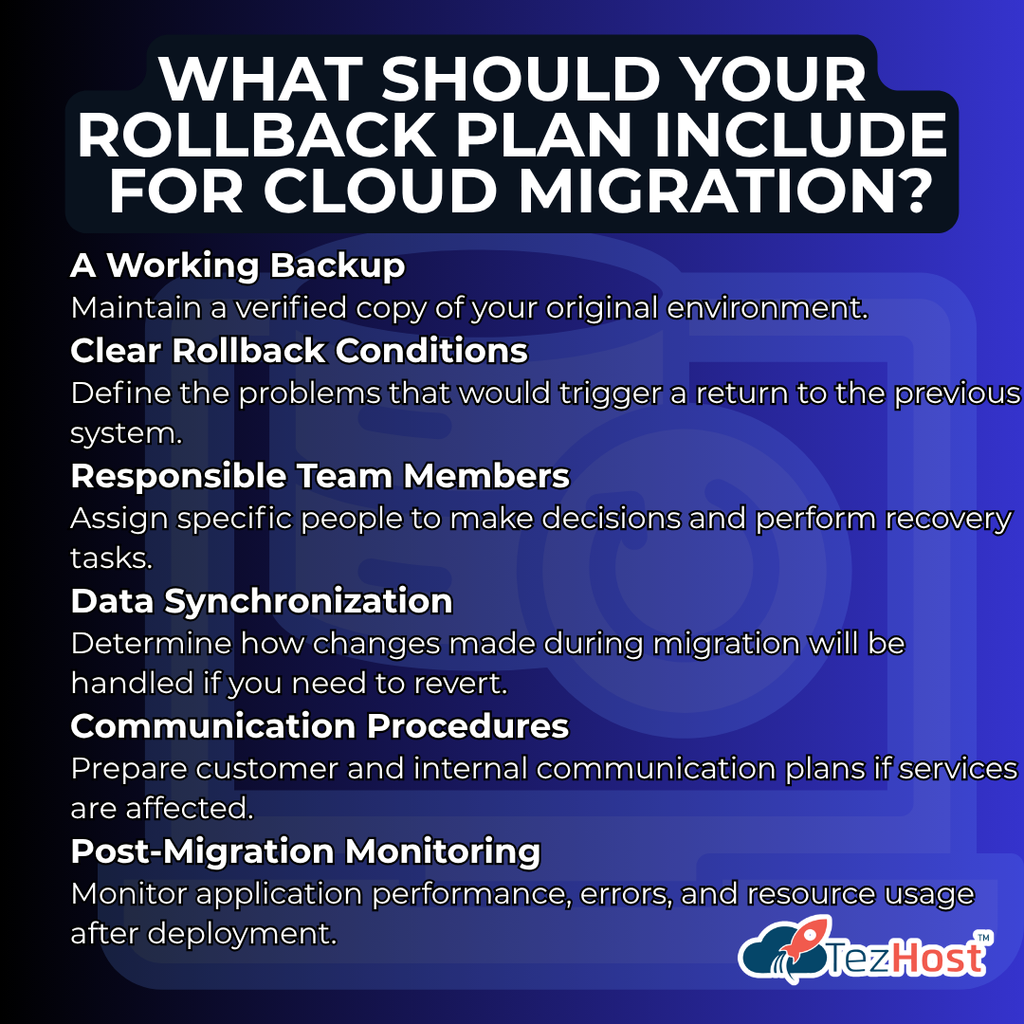
What Should Your Rollback Plan Include?
A Working Backup
Maintain a verified copy of your original environment.
Clear Rollback Conditions
Define the problems that would trigger a return to the previous system.
Responsible Team Members
Assign specific people to make decisions and perform recovery tasks.
Data Synchronization
Determine how changes made during migration will be handled if you need to revert.
Communication Procedures
Prepare customer and internal communication plans if services are affected.
Post-Migration Monitoring
Monitor application performance, errors, and resource usage after deployment.
When Is Cloud Migration Considered Successful?
Cloud migration is successful when the required applications and data are transferred, functionality is verified, security controls are in place, and the new environment meets agreed performance and business requirements.
A successful file transfer alone isn’t enough.
Our recommendation: Keep the migration project open until post-migration testing and monitoring confirm that the new environment is operating as expected.
Cloud Migration Checklist: What Should You Prepare Before Moving?
Before starting your migration, use this practical cloud migration checklist to confirm that the important decisions have been addressed.
| Checklist Item | What to Confirm |
|---|---|
| Migration Goals | Business objectives and expected outcomes |
| Infrastructure Assessment | Existing CPU, RAM, storage, and traffic usage |
| Application Inventory | Software, databases, and dependencies |
| Cost Planning | Migration expenses and ongoing cloud costs |
| Provider Selection | Infrastructure, pricing, security, and support |
| Data Protection | Verified backups and secure transfer procedures |
| Security | Access controls, updates, firewalls, and compliance |
| Migration Strategy | Migration order, responsibilities, and timeline |
| Downtime Planning | Maintenance windows and communication |
| DNS Configuration | Records, TTL settings, and cutover process |
| Testing | Website, database, application, and integration checks |
| Rollback Strategy | Recovery procedures and decision criteria |
| Monitoring | Performance and error monitoring after migration |
| Documentation | Updated infrastructure and operating procedures |
The goal isn’t simply to move your infrastructure. It’s to move it safely, efficiently, and with a clear understanding of what comes next.
Which Hosting Solution Should You Choose Before Migrating?
Your cloud migration checklist should also help determine whether cloud hosting is the right solution for your workload.
Not every website or application requires a cloud server.
Different businesses have different requirements.
| Hosting Solution | Best Suited For |
|---|---|
| Shared Hosting | Small websites, blogs, and basic business websites |
| VPS Hosting | Custom applications and businesses requiring virtual server control |
| Cloud Servers | Workloads requiring flexible virtualized infrastructure |
| Dedicated Servers | Resource-intensive applications requiring exclusive physical hardware |
Explore TezHost Hosting Options
For small websites: TezHost cPanel Web Hosting offers an option for customers who prefer straightforward website management.
For custom applications: TezHost VPS Hosting provides virtual server options for workloads requiring greater configuration control.
For cloud infrastructure: TezHost Cloud Servers are designed for businesses exploring virtualized computing resources.
For demanding applications: TezHost Dedicated Servers provide exclusive physical infrastructure.
For domain management: Explore TezHost Domain Registration when planning your website’s online identity and DNS configuration.
Not sure which solution fits your project?
Talk to a TezHost sales agent to discuss your requirements.
How Is TezHost Revolutionizing Cloud Migration with Its Approach?
At TezHost, we believe a successful cloud migration checklist should lead to more than a change of hosting provider.
It should help businesses make smarter infrastructure decisions, reduce unnecessary complexity, and prepare for future growth.
Our approach focuses on accessible hosting solutions, flexible infrastructure options, and customer-focused assistance.
1. Making Cloud Infrastructure More Accessible
Cloud technology shouldn’t be limited to large enterprises with extensive IT budgets.
TezHost offers hosting solutions for startups, developers, small businesses, and established organizations.
By providing different server configurations and hosting options, we help customers explore infrastructure suited to their workloads.
2. Helping Businesses Choose the Right Resources
Not every application requires a large cloud server.
Some websites operate effectively on shared hosting, while custom applications may need VPS or cloud infrastructure.
We encourage customers to consider CPU, RAM, storage, bandwidth, and software requirements before purchasing.
3. Supporting Modern Applications and Development
Today’s businesses increasingly depend on custom applications, development environments, automation platforms, and digital services.
TezHost offers infrastructure options that can support a variety of technical workloads.
4. Providing Multiple Hosting Options
Businesses may have different infrastructure needs at different stages.
TezHost provides access to shared hosting, VPS hosting, cloud servers, and dedicated servers.
This allows customers to evaluate hosting options based on their current requirements and future plans.
5. Making Hosting Decisions Easier
Cloud migration can be technically challenging, especially for businesses without dedicated infrastructure teams.
Our sales team helps customers understand available hosting options and identify configurations that fit their needs.
Why move to the cloud without understanding what your business actually requires?
Speak directly with a TezHost sales agent and explore a suitable hosting solution.
Visit TezHost to learn more about our services.
Frequently Asked Questions About Cloud Migration
1. What should I check before migrating to the cloud?
A cloud migration checklist should cover business goals, application compatibility, infrastructure requirements, migration costs, security, backups, downtime, scalability, and rollback procedures.
These factors help businesses identify potential risks before moving critical workloads.
2. What are the biggest risks of cloud migration?
Common risks include data loss, unexpected downtime, application compatibility problems, security misconfigurations, unexpected costs, and incomplete migration planning.
These risks can be reduced through testing, verified backups, careful scheduling, and documented recovery procedures.
3. How long does cloud migration take?
Cloud migration can take anywhere from a few hours for a simple website to several weeks or months for complex business infrastructure.
The timeline depends on data volume, application complexity, testing requirements, and migration strategy.
4. Can I migrate my website to the cloud without losing data?
Yes. A website can be migrated without data loss when files, databases, configurations, and changes made during the migration are properly transferred and validated.
Verified backups and data synchronization are particularly important for frequently updated websites.
5. Is moving to the cloud expensive?
Cloud migration costs vary according to application complexity, data volume, infrastructure requirements, and technical work.
Cloud hosting may reduce certain hardware expenses, but businesses should calculate total migration and ongoing operating costs before making a decision.
6. Do small businesses need cloud hosting?
Not every small business needs cloud hosting.
A basic website may operate effectively on shared hosting.
Businesses running custom applications or requiring more infrastructure flexibility may benefit from VPS or cloud servers.
7. What is the first step in cloud migration?
The first step is assessing your existing infrastructure and defining your migration goals.
Identify the applications, data, dependencies, and business requirements involved before choosing a provider or migration method.
8. Should I move all my applications to the cloud at once?
Not necessarily.
For complex environments, a phased migration can reduce operational risk.
Businesses can begin with less critical applications, validate the process, and then migrate more important systems.
9. How do I choose the best cloud migration provider?
Compare providers based on infrastructure performance, pricing transparency, security, support, server locations, available resources, and migration assistance.
The best provider is the one whose services align with your technical and business requirements.
For guidance, contact a TezHost sales agent.
10. What happens after cloud migration?
After migration, businesses should test applications, verify data integrity, monitor performance, review security settings, update documentation, and confirm that the new environment meets their objectives.
Post-migration monitoring is essential for identifying issues that may not appear during initial testing.
Conclusion: Make Your Cloud Migration a Smart Business Decision
Before moving, make sure you understand your business goals, application requirements, security responsibilities, expected expenses, and recovery options.
The most successful migrations aren’t necessarily the fastest.
They’re the ones that are carefully planned, properly tested, and aligned with business needs.
At TezHost, we believe cloud hosting should be accessible, practical, and suited to the requirements of each customer.
Whether you’re moving a small business website, deploying a custom application, or exploring cloud infrastructure for future growth, choosing the right hosting environment is an important first step.
Ready to Move to the Cloud?
Don’t make your migration decision based on guesswork.
Explore TezHost Cloud Servers and discover hosting options for your next project.
Need help choosing the right configuration? Talk to a TezHost sales agent today.
Or register with TezHost and take the next step toward your cloud hosting journey.
Plan carefully. Migrate confidently. Build for growth.