Cloud server total cost depends on several factors, including CPU, RAM, storage, bandwidth, operating system, security, backups, and management requirements. While some entry-level cloud servers cost less than $10 per month, business-grade configurations can cost $30–$150 or more, depending on their resources and additional services.
For startups, developers, and growing businesses, understanding the cost to run a cloud server is essential before investing in cloud infrastructure.
The good news? Cloud hosting can be affordable when you understand what you’re paying for and select the right resources.
At TezHost, we believe businesses should have access to powerful cloud infrastructure without unnecessary complexity or unexpected expenses.
Ready to get started? Register with TezHost to explore hosting solutions designed for different business requirements.
In this guide, we’ll break down the seven major expenses involved in running a cloud server, explain how to calculate your monthly costs, and share practical ways to reduce your cloud hosting expenses.
1. How Much Does a Cloud Server Cost Per Month?
The cloud server total cost can range from under $10 to several hundred dollars per month, depending on the server’s specifications, provider, and additional services.
Here is a general pricing breakdown:
| Cloud Server Type | Estimated Monthly Cost | Suitable For |
|---|---|---|
| Entry-Level Cloud Server | $5–$15 | Testing, development, small websites |
| Small Business Cloud Server | $15–$40 | Business websites, lightweight applications |
| Medium Cloud Server | $40–$100 | E-commerce, growing applications |
| High-Performance Cloud Server | $100–$300+ | Resource-intensive applications |
| Enterprise Cloud Infrastructure | $300–$1,000+ | Large applications, complex infrastructure |
These are illustrative market ranges, not guaranteed TezHost prices. Actual charges vary by provider, region, configuration, and billing model.
For example, a small business running a WordPress website may only need a modest cloud server. However, an e-commerce platform handling thousands of visitors could require more RAM, CPU resources, and storage.
To explore this further, read our guide on cloud server cost per month.
You can also explore TezHost Cloud Servers to find a suitable configuration.
Need help choosing a server within your budget? Talk to a TezHost sales agent for guidance.
2. What Factors Determine Cloud Server Total Cost?
The cloud server total cost is primarily determined by computing resources, storage requirements, data transfer, software licensing, security, and management services.
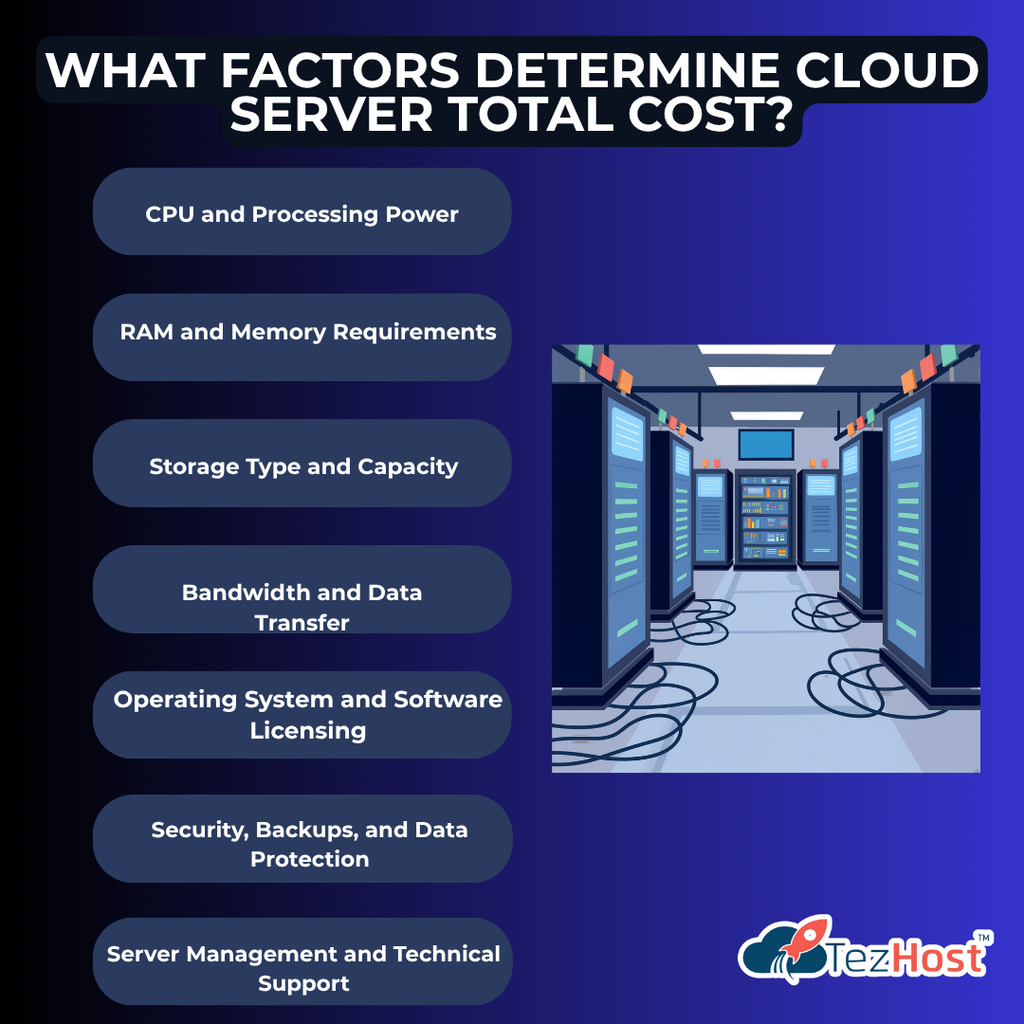
Let’s examine the seven expenses that affect your monthly cloud hosting bill.
1. CPU and Processing Power
CPU resources determine how much processing work your cloud server can handle.
More virtual CPU cores generally mean greater processing capacity, but they can also increase hosting expenses.
For example:
- 1–2 vCPUs: Suitable for lightweight websites and testing.
- 2–4 vCPUs: Often sufficient for small business applications.
- 4–8 vCPUs: Useful for growing websites and moderately demanding workloads.
- 8+ vCPUs: Better suited to resource-intensive applications.
The right configuration depends on your workload rather than visitor numbers alone.
Cost-saving tip: Start with the processing capacity your application needs and scale when monitoring data shows sustained demand.
2. RAM and Memory Requirements
RAM affects how efficiently your server handles applications, databases, and simultaneous processes.
A website with limited traffic may function well with 2–4 GB RAM, while a busy e-commerce platform or database-driven application may require substantially more.
Insufficient memory can lead to slow performance, application failures, or excessive disk swapping.
However, paying for significantly more RAM than you use increases your monthly bill.
Cost-saving tip: Monitor memory consumption before upgrading.
3. Storage Type and Capacity
Cloud storage pricing depends on the amount of storage and the technology used.
Common storage options include:
- HDD storage: Often economical for workloads that do not require high disk performance.
- SSD storage: Faster than traditional HDDs.
- NVMe SSD storage: Designed for workloads that benefit from high-speed storage access.
A small website may need only 20–40 GB of storage, while a business application with extensive databases or uploaded media could require hundreds of gigabytes.
Additional storage volumes, snapshots, and backup retention can increase costs.
Cost-saving tip: Choose storage based on performance requirements and realistic data growth.
4. Bandwidth and Data Transfer
Bandwidth is another important component of cloud hosting expenses.
Some hosting providers include a fixed monthly data transfer allowance, while others charge for usage.
For example, a website delivering large images, downloadable files, or video content may generate more outbound traffic than a basic company website.
Data transfer costs may increase because of:
- High website traffic.
- Large downloadable files.
- Media streaming.
- Application-to-application communication.
- Traffic between cloud regions.
Cost-saving tip: Check included transfer allowances and overage rates before selecting a plan.
5. Operating System and Software Licensing
The operating system can influence your cloud server total cost.
Linux distributions are generally available without operating-system license fees, while Windows Server and some commercial software may involve additional licensing costs.
You may also need paid software for:
- Control panels.
- Database management.
- Security monitoring.
- Commercial application licenses.
- Server management.
For businesses that prefer a graphical hosting interface, cPanel Web Hosting may be worth considering instead of maintaining an unmanaged cloud server.
6. Security, Backups, and Data Protection
Security and backup services are essential considerations when calculating the cloud server total cost.
Potential expenses include:
- Automated backups.
- Backup storage and retention.
- Advanced firewalls.
- Malware protection.
- Monitoring services.
- Disaster recovery infrastructure.
Although some security features may be included in a hosting plan, advanced protection and recovery services can cost extra.
Skipping backups to reduce expenses can be a costly mistake.
For practical recommendations, read Data Protection and Cost-Saving Tips.
Cost-saving tip: Review which security and backup services are included before purchasing additional tools.
7. Server Management and Technical Support
The final major expense is server administration.
With unmanaged cloud hosting, customers typically handle operating system updates, application configuration, monitoring, and troubleshooting themselves.
Managed hosting generally costs more because the provider handles some administrative responsibilities.
Businesses without dedicated technical staff should consider the time and expertise required to manage infrastructure.
Cost-saving tip: Compare the cost of managed services against the time your team would otherwise spend maintaining the server.
3. How Do You Calculate Cloud Server Total Cost?
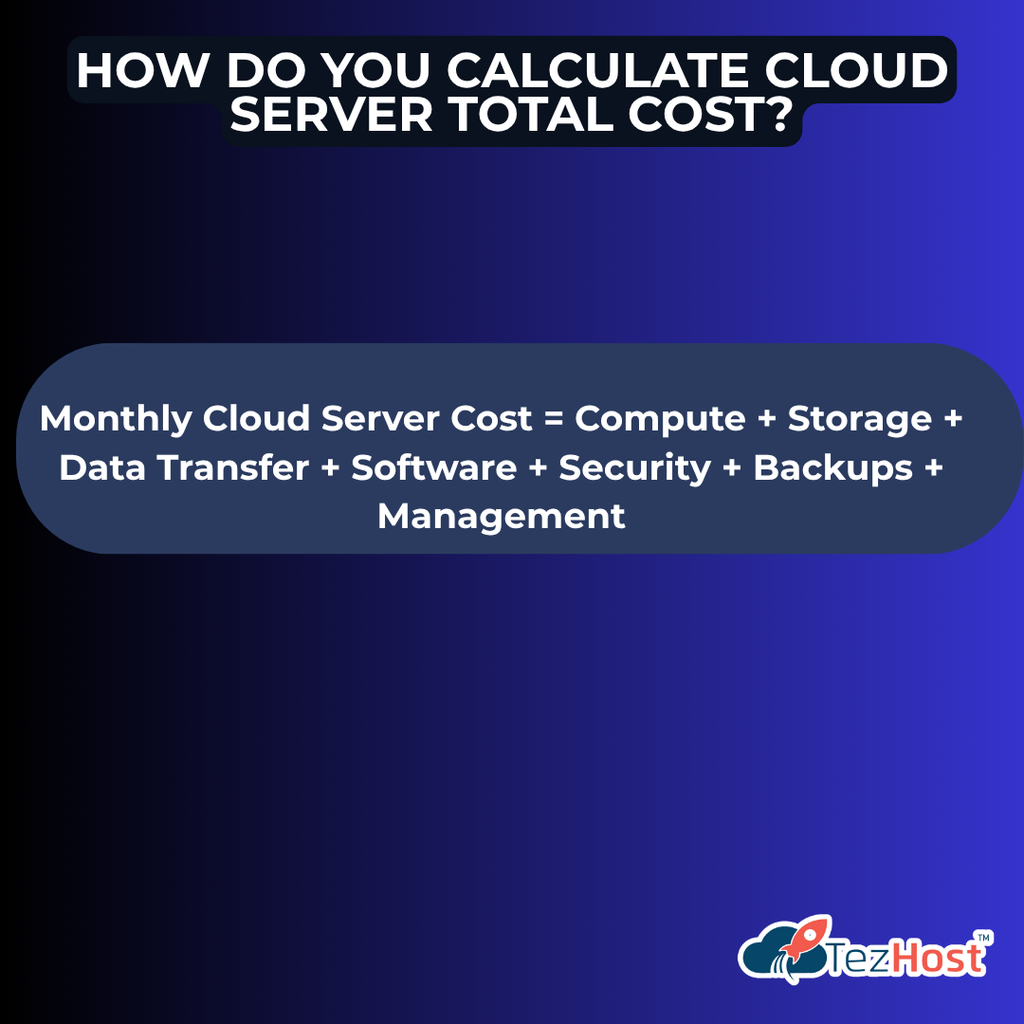
You can calculate the cloud server total cost by adding the base hosting price to additional charges for storage, bandwidth, software, backups, security, and management.
A simple formula is:
Monthly Cloud Server Cost = Compute + Storage + Data Transfer + Software + Security + Backups + Management
Consider this hypothetical small business example:
| Expense | Estimated Monthly Cost |
|---|---|
| Cloud Server (CPU and RAM) | $25 |
| Additional Storage | $5 |
| Additional Bandwidth | $0 |
| Backup Service | $5 |
| Security Tools | $5 |
| Management | $0 |
| Total Monthly Cost | $40 |
In this example, the business spends approximately $40 per month or $480 annually, excluding taxes, setup fees, and other variable charges.
This illustrates why the advertised server price isn’t always the complete cost.
For a broader comparison, explore our article on Cloud Cost Comparison: Cloud vs. On-Premises.
If you want help estimating your requirements, connect with a TezHost sales agent.
4. Is Cloud Hosting Cheaper Than Traditional Hosting?
The cloud server total cost may be higher than basic shared hosting, but cloud servers can offer greater resource control, flexibility, and scalability.
The most economical solution depends on your application and business requirements.
Cloud Hosting vs. Shared Hosting
Shared hosting is generally more affordable because multiple websites share server resources.
Cloud servers offer more control over allocated computing resources and server configuration.
For basic websites and blogs, cPanel Web Hosting may be sufficient.
For applications requiring dedicated virtual resources and greater configuration flexibility, Cloud Servers may be more suitable.
Cloud Hosting vs. VPS Hosting
Cloud servers and VPS hosting can provide similar functionality, but their infrastructure and scaling capabilities vary by provider.
Some cloud platforms support rapid provisioning, flexible resource allocation, and advanced infrastructure features.
Traditional VPS solutions may provide predictable pricing for stable workloads.
Explore TezHost VPS Hosting to compare available options.
Cloud Hosting vs. Dedicated Servers
Dedicated servers provide physical hardware resources allocated to one customer.
Cloud servers typically use virtualized infrastructure and can be easier to provision or resize.
For businesses with stable, resource-intensive workloads, Dedicated Servers may be worth evaluating.
Which is cheaper?
Shared hosting is often the lowest-cost starting point. VPS and cloud hosting provide greater flexibility, while dedicated infrastructure may be appropriate for demanding workloads.
The best choice depends on total operating costs, performance requirements, and expected growth.
5. How Can You Reduce Cloud Server Total Cost?
Reducing your cloud server total cost doesn’t necessarily mean choosing the cheapest hosting plan. It means eliminating unnecessary expenses while maintaining the performance your applications need.
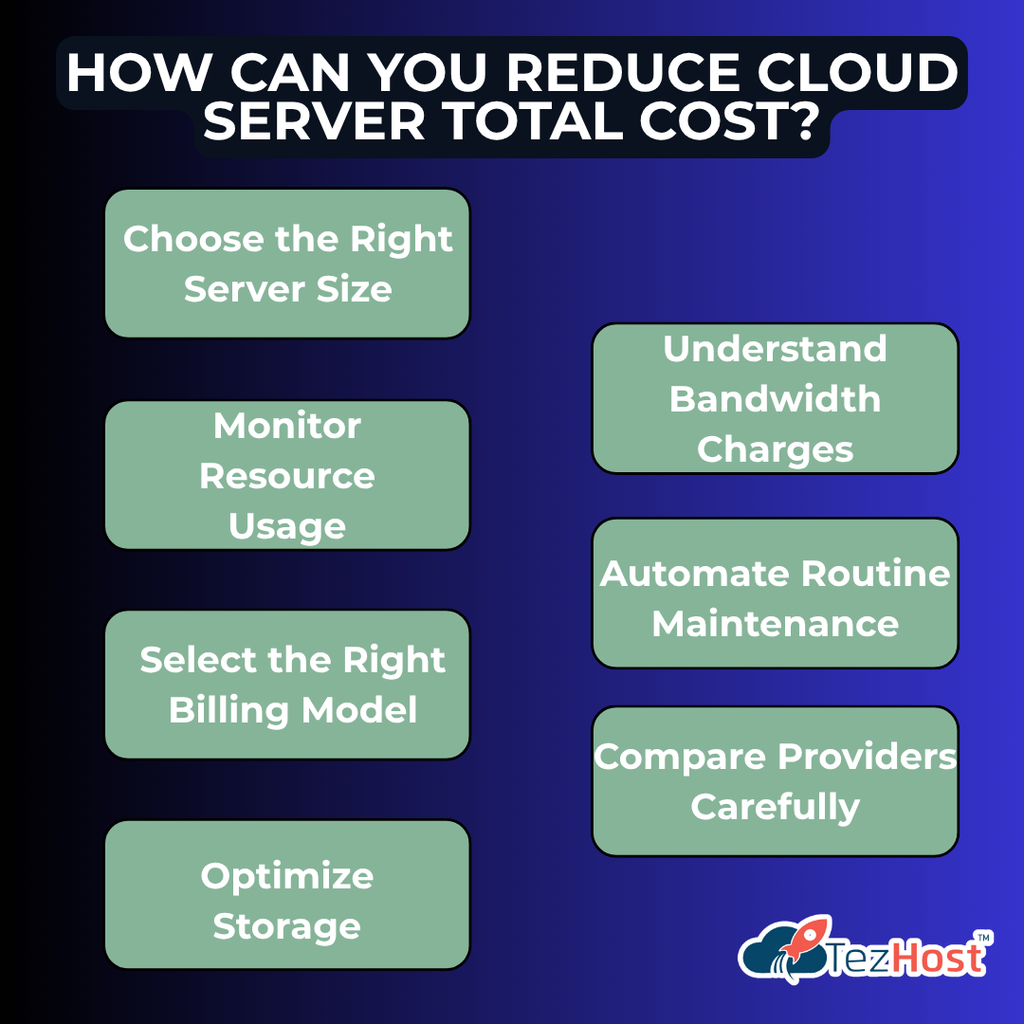
Here are seven practical strategies.
1. Choose the Right Server Size
Avoid purchasing excessive CPU and RAM resources before your application requires them.
2. Monitor Resource Usage
Track CPU, memory, disk utilization, and network traffic to identify unused capacity.
3. Select the Right Billing Model
Compare fixed monthly pricing with hourly or usage-based billing.
For continuously running workloads, predictable monthly plans may simplify budgeting.
4. Optimize Storage
Remove unnecessary files, archive older data, and review backup retention policies.
5. Understand Bandwidth Charges
Review transfer limits and use appropriate caching or content delivery solutions where beneficial.
6. Automate Routine Maintenance
Automation can reduce repetitive administrative work and improve operational efficiency.
7. Compare Providers Carefully
Evaluate the complete hosting package rather than focusing only on the advertised monthly price.
Our guide to Cheap Cloud Server Hosting: Top Affordable Options explains what to consider when comparing affordable services.
You can also review 6 Top Cloud Providers to Find Your Cloud Solution for additional guidance.
6. How Is TezHost Revolutionizing Cloud Hosting with Its Approach?
At TezHost, we understand that controlling the cloud server total cost is a priority for startups, developers, entrepreneurs, and established businesses.
Our approach focuses on combining accessible cloud infrastructure with practical hosting solutions that businesses can select according to their requirements.
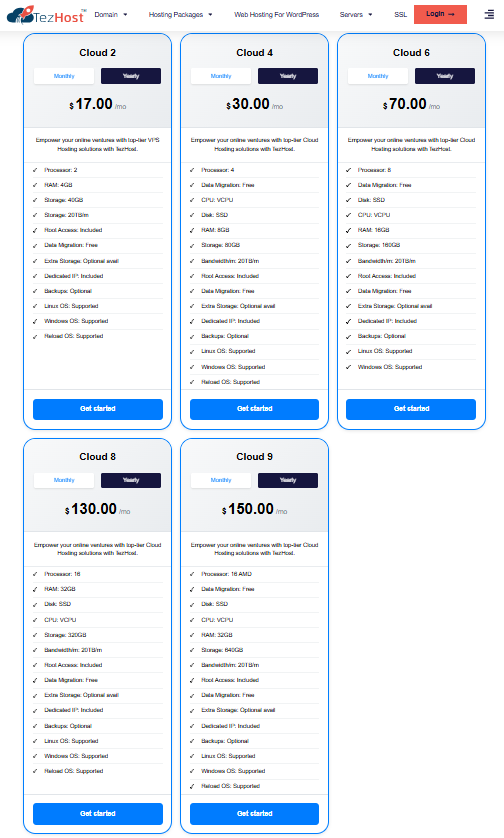
Affordable Cloud Infrastructure
TezHost offers cloud hosting options for different workloads and budgets.
Instead of assuming every business needs expensive infrastructure, we encourage customers to evaluate the resources their applications actually require.
Explore our Cloud Server Hosting Solutions to learn more.
Performance-Focused Technology
Modern applications require infrastructure that can support changing workloads.
TezHost offers cloud solutions designed around computing performance, resource allocation, and business requirements.
For organizations exploring emerging technologies, our AI-Optimized Cloud Servers provide another option to investigate.
Flexible Hosting Options
Different businesses have different infrastructure requirements.
TezHost provides access to:
- Cloud Servers for virtualized hosting infrastructure.
- VPS Hosting for businesses requiring virtual private server resources.
- cPanel Web Hosting for websites that benefit from simplified hosting management.
- Dedicated Servers for demanding workloads.
- Domain Registration for establishing an online presence.
This variety helps customers select a solution based on their technical requirements instead of adopting a one-size-fits-all approach.
Customer-Focused Assistance
Choosing the right cloud server can be challenging, particularly for businesses without an in-house infrastructure team.
TezHost helps customers explore suitable hosting options based on their applications, resource requirements, and budgets.
Why pay for resources you may not need?
Talk to a TezHost sales agent today and discuss the cloud hosting solution that fits your business.
Visit TezHost to explore our services.
7. Is Running a Cloud Server Worth the Cost?
The cloud server total cost can be worthwhile when your business needs greater resource control, flexibility, and room for growth.
Cloud hosting is particularly useful for businesses operating:
- E-commerce websites.
- Custom web applications.
- Business management systems.
- Development and testing environments.
- Database-driven platforms.
- SaaS applications.
- Applications with changing resource requirements.
However, cloud hosting isn’t automatically the best choice for every website.
A small blog or basic business website may operate effectively on shared hosting at a lower monthly cost.
The key is matching your hosting environment to your actual requirements.
Frequently Asked Questions About Cloud Server Costs
1. How much does it cost to run a cloud server monthly?
The cloud server total cost can start below $10 per month for basic configurations and exceed $100 monthly for more demanding applications. Enterprise infrastructure may cost considerably more.
The final amount depends on resources, software, storage, traffic, and management requirements.
2. What is the cheapest way to run a cloud server?
The cheapest practical approach is to select a small server that meets your application’s minimum requirements, use suitable software, monitor resource usage, and avoid unnecessary paid services.
However, security, backups, and reliability should not be sacrificed simply to reduce costs.
3. Is a cloud server cheaper than a physical server?
A cloud server can be cheaper for small workloads or applications with changing resource requirements because businesses avoid purchasing and maintaining physical hardware.
For large, continuously running workloads, dedicated infrastructure may sometimes offer better economics.
4. Do cloud servers charge for bandwidth?
Some providers include a monthly transfer allowance, while others charge for outbound traffic or additional data usage.
Always check bandwidth limits and overage pricing.
5. Can I run a cloud server for free?
Some cloud providers offer limited free trials or free-tier resources.
However, free offerings typically have restrictions on computing resources, storage, usage, or duration.
Businesses should review billing conditions carefully before deploying applications.
6. How much does a cloud server cost annually?
Annual cloud server expenses depend on the monthly bill and any applicable annual discounts.
For example:
- $10/month = $120/year.
- $25/month = $300/year.
- $50/month = $600/year.
- $100/month = $1,200/year.
These calculations exclude additional charges such as taxes, paid backups, software licenses, and bandwidth overages.
7. What hidden costs should I watch for in cloud hosting?
Common additional cloud hosting expenses include data transfer overages, backup storage, software licensing, monitoring, managed support, and additional storage volumes.
Always review the full pricing structure before purchasing a cloud server.
8. How do I choose the right cloud server for my business?
Start by identifying your application’s CPU, RAM, storage, traffic, operating system, and security requirements.
Then compare hosting plans based on total monthly expenses, support availability, scalability, and performance.
For personalized assistance, contact a TezHost sales agent.
Conclusion: Understand Your Cloud Server Total Cost Before You Buy
Understanding your cloud server total cost is essential for making informed infrastructure decisions.
The cheapest advertised server isn’t always the most economical option, and the most expensive configuration isn’t necessarily the best.
CPU, RAM, storage, bandwidth, security, software licensing, and management all contribute to your final hosting expenses.
By evaluating these factors carefully, businesses can avoid unnecessary spending while choosing infrastructure that supports their growth.
At TezHost, our goal is to make cloud hosting more accessible by helping customers explore solutions that fit their technical and financial requirements.
Ready to take control of your cloud hosting expenses?
Explore TezHost Cloud Servers and discover hosting options for your next project.
Need guidance before purchasing? Speak directly with a TezHost sales agent.
Or register with TezHost today and take the next step toward building your online infrastructure.
Your cloud infrastructure should support your business growth—not create unnecessary expenses.