
You can start a cloud hosting business as a side gig without building your own data center or purchasing expensive server infrastructure. The practical approach is to start with a reseller model, use an established hosting provider for the underlying infrastructure, and focus your time on acquiring customers, building your brand, and providing excellent service.
If you already work as a freelancer, web developer, designer, digital marketer, IT consultant, or agency owner, a cloud hosting business can become a natural addition to the services you already offer.
Instead of earning only from one-time website projects, you can add recurring hosting services to your portfolio.
You can Register with TezHost here and explore the available hosting options as you build your business model.
What Is a Cloud Hosting Business?
A cloud hosting business allows you to sell hosting services to customers while relying on cloud infrastructure provided by an established hosting company.
In a traditional hosting company, you may need to invest in servers, networking equipment, monitoring systems, security infrastructure, technical staff, and data-center operations. A reseller model significantly reduces that barrier.
The basic model is straightforward:
Hosting provider → Your hosting business → Your customers
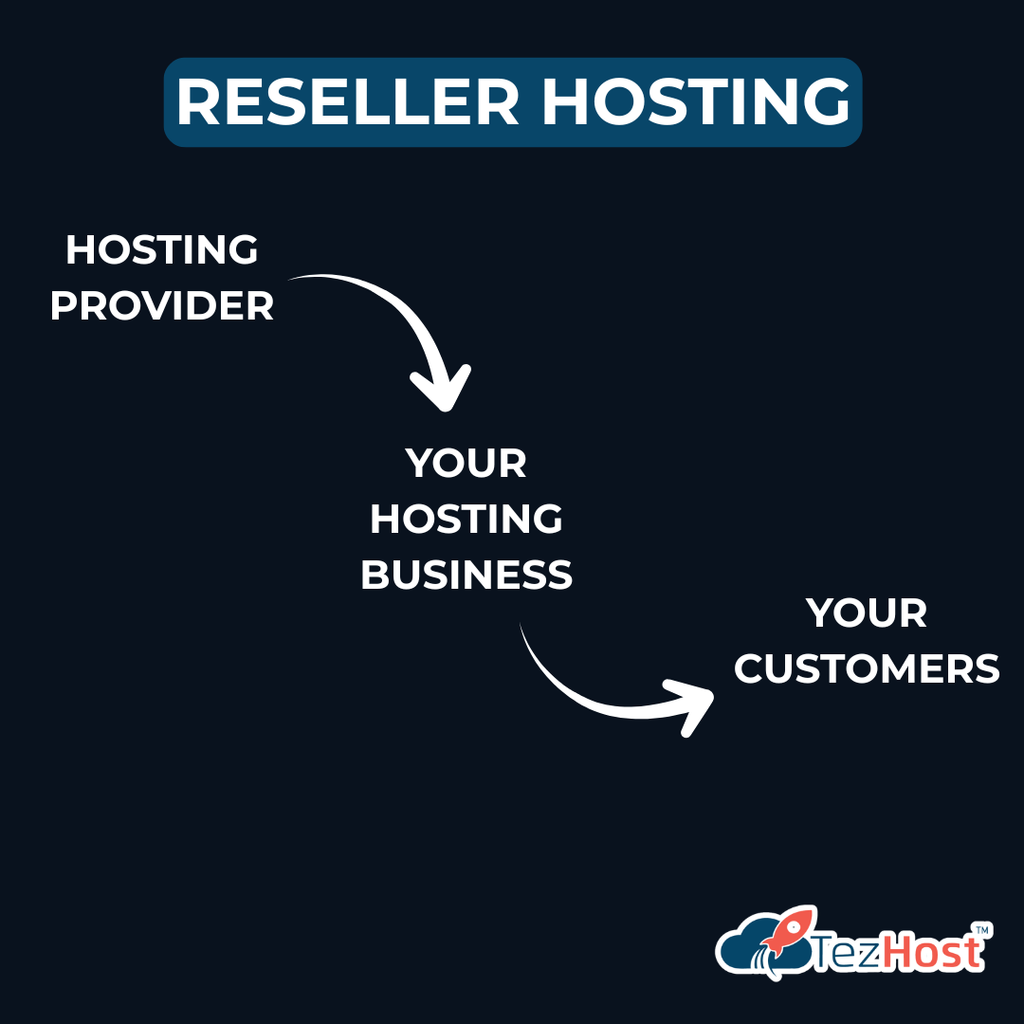
You purchase hosting resources or reseller capacity from a provider and package those resources into services for your customers. You determine your pricing, branding, packages, and customer relationships.
This is why a cloud hosting business can be attractive as a side gig: you can concentrate on the commercial side instead of trying to become a data-center operator.
If you want to understand how cloud infrastructure works in greater detail, read TezHost’s guide on how to migrate to cloud servers.
Is Starting a Cloud Hosting Business a Good Side Gig?
Yes, but it works best when you treat it as a real business rather than passive income.
A cloud hosting business can provide recurring revenue because customers generally need hosting for as long as their websites, applications, stores, or online services remain active.
However, hosting is not completely passive.
You may need to:
- Find and onboard customers
- Create hosting packages
- Handle billing and renewals
- Answer basic support questions
- Help customers with migrations
- Monitor customer satisfaction
- Market your hosting brand
- Upgrade resources as customers grow
The good news is that you don’t have to perform every infrastructure task yourself.
With the right provider, much of the underlying server management can remain with the infrastructure company while you concentrate on your customers.
For agencies and freelancers, this can be especially useful because hosting can be bundled with services they already provide.
For example:
Website development + domain + hosting + maintenance = recurring client relationship
Instead of handing your website client a finished website and watching them purchase hosting somewhere else, you can offer the complete package.
5 Ways to Start a Cloud Hosting Business as a Side Gig
1. Start With Reseller Hosting Instead of Buying Servers
The easiest way to start a cloud hosting business is usually to avoid purchasing physical infrastructure at the beginning.
Reseller hosting allows you to purchase hosting resources from an established provider and sell hosting services under your own business model.
TezHost offers Reseller Web Hosting for people who want to build a hosting business without taking on the cost and complexity of managing their own physical infrastructure.
This approach can be particularly useful if you’re testing the market.
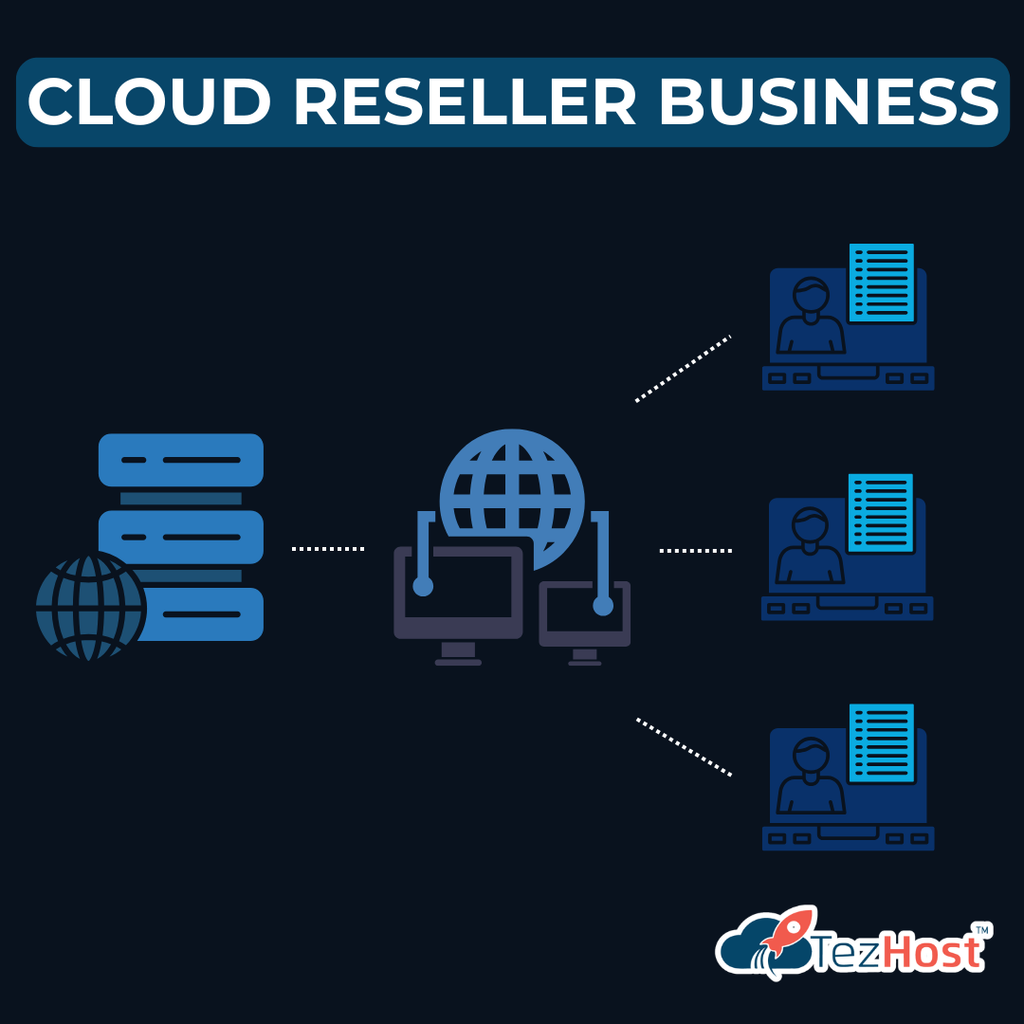
You can start with a smaller customer base, learn what customers actually need, refine your packages, and scale when demand increases.
You can also explore TezHost’s guide on reseller hosting for agencies and profit strategies to understand how hosting can complement an existing agency business.
Why reseller hosting works for a side gig
You don’t necessarily need:
- Your own data center
- A large technical team
- Physical servers
- Complex networking infrastructure
- A large upfront investment
Instead, you can focus on:
- Branding
- Sales
- Marketing
- Customer relationships
- Package creation
- Support
- Business growth
That makes reseller hosting one of the most accessible ways to test a cloud hosting business idea.
2. Choose the Right Infrastructure Provider
Your provider can make or break your cloud hosting business.
Even if your customers interact with your brand, problems with infrastructure can ultimately affect your reputation.
Before selecting a provider, evaluate:
Reliability
Look for strong uptime, reliable infrastructure, monitoring, and appropriate redundancy.
Scalability
Your hosting requirements will change as your customer base grows. Make sure you can move from smaller hosting resources to VPS, cloud, or dedicated infrastructure when required.
Security
Security should be part of your evaluation from day one. Look for features such as malware protection, backups, SSL support, monitoring, and server-level security.
Customer Support
When you are running a side business, you cannot afford to spend hours trying to solve infrastructure problems that are outside your expertise.
A responsive provider gives you somewhere to escalate technical issues.
Available Hosting Options
A good infrastructure partner should allow you to expand beyond your initial offering.
For example, TezHost provides options including Cloud Servers, VPS Hosting, cPanel Hosting, and Dedicated Servers.
That gives a growing cloud hosting business multiple infrastructure options instead of forcing you to change providers as your customers become more demanding.
For more guidance, read How to Choose the Best Web Hosting.
3. Build Your Hosting Business Around Customers You Already Have
The easiest customer for a new cloud hosting business may already be in your network.
Think about the people you already serve.
If you’re a:
- Web developer
- WordPress developer
- Graphic designer
- SEO consultant
- Digital marketing agency
- Software developer
- IT consultant
- Freelancer
you may already have customers who need hosting.
For example, imagine you build five websites every month.
Instead of simply delivering the websites, you could offer:
Website + Domain + Hosting + Maintenance
The hosting component then becomes an ongoing service rather than a one-time transaction.
This is where a cloud reseller business can become particularly powerful.

You don’t necessarily need thousands of customers immediately. A small number of loyal business clients can provide a foundation on which you build.
Where can you find customers?
Consider:
- Existing clients
- Freelance marketplaces
- Local businesses
- E-commerce businesses
- Startups
- Digital agencies
- Referral partnerships
- Web designers
- Developers
You can also offer hosting as an add-on to existing services.
For example:
“We can build your website, register your domain, host it, and keep everything maintained for you.”
That is a much stronger proposition than simply saying:
“We sell hosting.”
4. Create Simple Hosting Packages
A successful cloud hosting business doesn’t need dozens of complicated plans.
Start with a small number of packages that customers can easily understand.
For example:
Starter
For personal websites, portfolios, and small business websites.
Business
For growing business websites, blogs, online stores, and higher-traffic websites.
Professional
For businesses that need more resources, performance, or scalability.
You can then offer additional services such as:
- Domain registration
- SSL
- Website migration
- Backups
- Website maintenance
- WordPress management
- Email hosting
- Security
- Performance optimization
You can also offer different infrastructure levels as customers grow.
For example, a small website might start with cPanel hosting, while a growing application could eventually move to VPS or cloud infrastructure.

If you are unsure which infrastructure is appropriate, TezHost’s guide on Cloud Servers vs. Dedicated Servers can help you understand the difference.
Don’t compete only on price
One of the biggest mistakes in a cloud hosting business is trying to become the cheapest provider.
Instead, compete on value.
Your package could include:
- Reliable infrastructure
- Easy migration
- Support
- Security
- Backups
- Monitoring
- Business guidance
- Fast communication
Customers often pay more for convenience and confidence.
5. Automate Your Side Gig as Much as Possible
If your cloud hosting business is going to remain a side gig, automation becomes extremely important.
You don’t want to manually perform every renewal, invoice, account setup, and customer notification.
As your business grows, consider automating:
- Customer onboarding
- Billing
- Renewal reminders
- Account provisioning
- Payment notifications
- Service upgrades
- Support ticket workflows
- Backup monitoring
- Customer emails
Automation lets you spend more time acquiring customers instead of performing repetitive administrative tasks.

It also makes your business easier to scale.
A hosting side gig with 10 customers can be managed manually.
A hosting business with 100 or 500 customers needs systems.
How Much Can You Make From a Cloud Hosting Side Gig?
A cloud hosting business can generate recurring revenue, but there is no guaranteed income figure.
Your potential revenue depends on factors such as:
- Number of customers
- Average price per customer
- Infrastructure costs
- Domain costs
- Software costs
- Payment processing fees
- Support requirements
- Customer retention
- Marketing expenses
For example, if you eventually have 50 customers paying an average of $10 per month for hosting, that represents $500 in monthly recurring revenue before expenses.
At 100 customers paying $15 per month, the revenue becomes $1,500 per month before expenses.
The important point is that these are examples, not guaranteed earnings.

Your actual profitability depends on your costs, pricing, customer acquisition, and the amount of support you provide.
That is why the best approach is to start small, understand your unit economics, and grow gradually.
Can You Run a Cloud Hosting Business With a Full-Time Job?
Yes. A cloud hosting business can be structured as a side gig if you keep the operation simple and automate repetitive tasks.
For someone with a full-time job, a sensible approach could be:
Phase 1: Start with a small reseller plan.
Phase 2: Get your first 5–10 customers.
Phase 3: Standardize your packages and pricing.
Phase 4: Automate billing and renewals.
Phase 5: Create a support process.
Phase 6: Increase your marketing.
Phase 7: Upgrade infrastructure when customer demand justifies it.
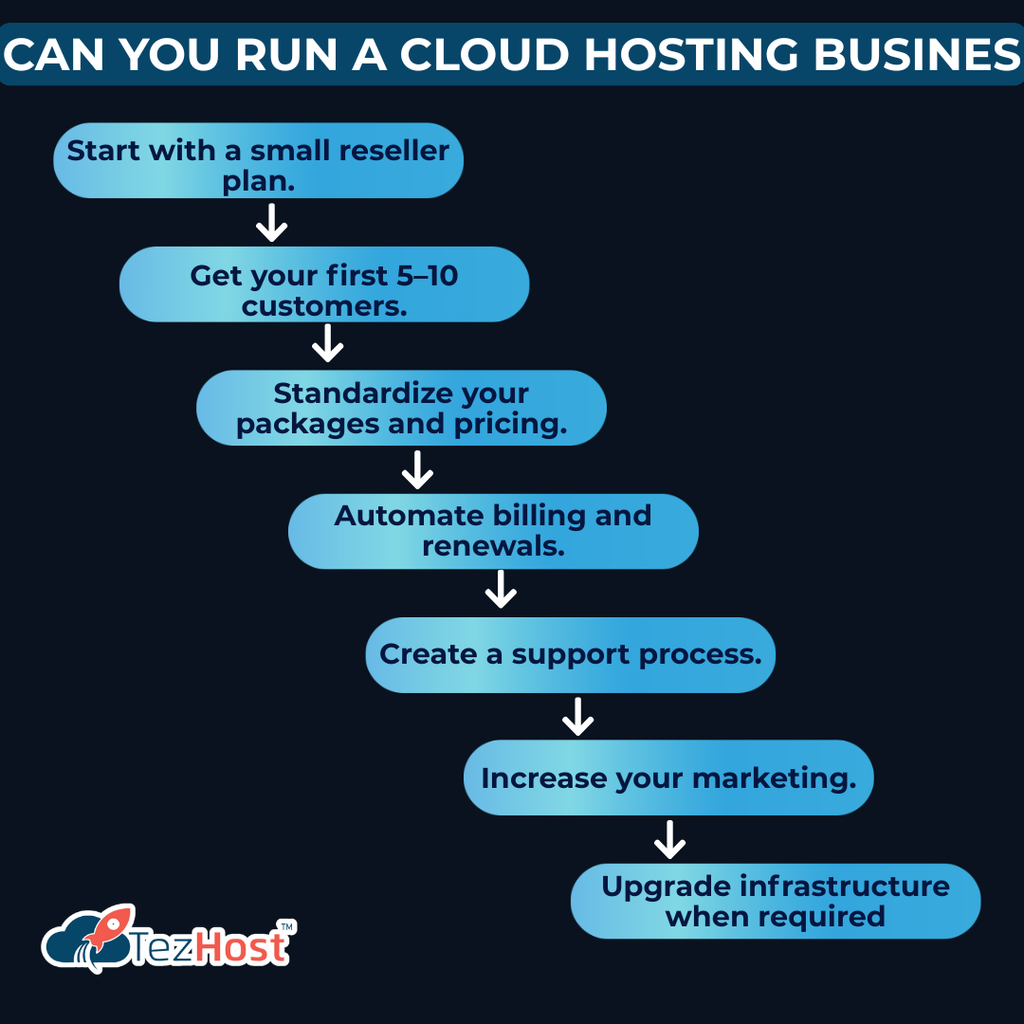
This approach prevents you from spending heavily before you have validated the business.
It also allows your cloud hosting business to grow alongside your existing career or business.
What Services Can You Sell With Your Cloud Hosting Business?
A cloud hosting business doesn’t have to make money from hosting alone.
You can build a broader digital services ecosystem around it.
1. Domain Registration
Sell domains alongside hosting through your domain registration services.
2. Website Hosting
Offer traditional cPanel hosting to customers who need straightforward website hosting.
3. VPS Hosting
Offer VPS Hosting to customers who need more control and resources.
4. Cloud Servers
For applications, development environments, growing websites, and businesses requiring scalable infrastructure, offer Cloud Servers.
5. Dedicated Servers
For demanding workloads, you can eventually offer Dedicated Servers.
6. Website Migration
Migration can be a valuable additional service because many customers don’t know how to safely move their websites between providers.
TezHost’s step-by-step cloud migration guide can also help you understand the process.
7. Maintenance and Management
You can offer ongoing website updates, security checks, backups, performance monitoring, and technical assistance.
This transforms your cloud hosting business from a simple hosting reseller operation into a broader recurring digital service.
How Can You Attract Your First Cloud Hosting Customers?
Your first customers are usually easier to acquire through relationships than through expensive advertising.
A cloud hosting business can start by targeting people who already trust you.
Try:
Existing Customers
Offer hosting to clients who already purchase websites, SEO, development, or marketing services from you.
Partnerships
Partner with web developers and designers who don’t want to manage hosting themselves.
Reach out to business owners, agencies, developers, and startups with a useful, non-spammy offer.
Content Marketing
Write articles answering questions such as:
- How much hosting does my website need?
- What is cloud hosting?
- Cloud hosting vs VPS: which is better?
- How do I migrate my website?
- Why is my website slow?
- When should I upgrade hosting?
For example, explain how cloud server hosting can help websites handle traffic spikes.
Referrals
Give existing customers an incentive to refer businesses to you.
The goal is not simply to sell hosting.
The goal is to become the person customers trust with their online infrastructure.
Is Cloud Reseller Hosting Better Than Buying Your Own Server?
For a beginner, a cloud hosting business built around reseller infrastructure is usually less risky than immediately purchasing and managing your own server.
Buying infrastructure can introduce additional responsibilities involving hardware, networking, security, monitoring, maintenance, backups, and technical expertise.
Reseller hosting lets you validate demand first.
Once your customer base becomes substantial, you can consider moving certain workloads to VPS, cloud, or dedicated infrastructure.
This creates a natural growth path:
Reseller Hosting → VPS → Cloud → Dedicated Infrastructure
The correct stage depends on your customers and workloads rather than simply choosing the most expensive infrastructure from day one.
How TezHost Is Revolutionizing the Cloud Hosting Business
TezHost is changing the traditional approach to hosting by making infrastructure more accessible to businesses, developers, agencies, and entrepreneurs.
Instead of expecting every entrepreneur to build and manage an entire hosting infrastructure stack, TezHost provides multiple hosting options that can support different stages of business growth.
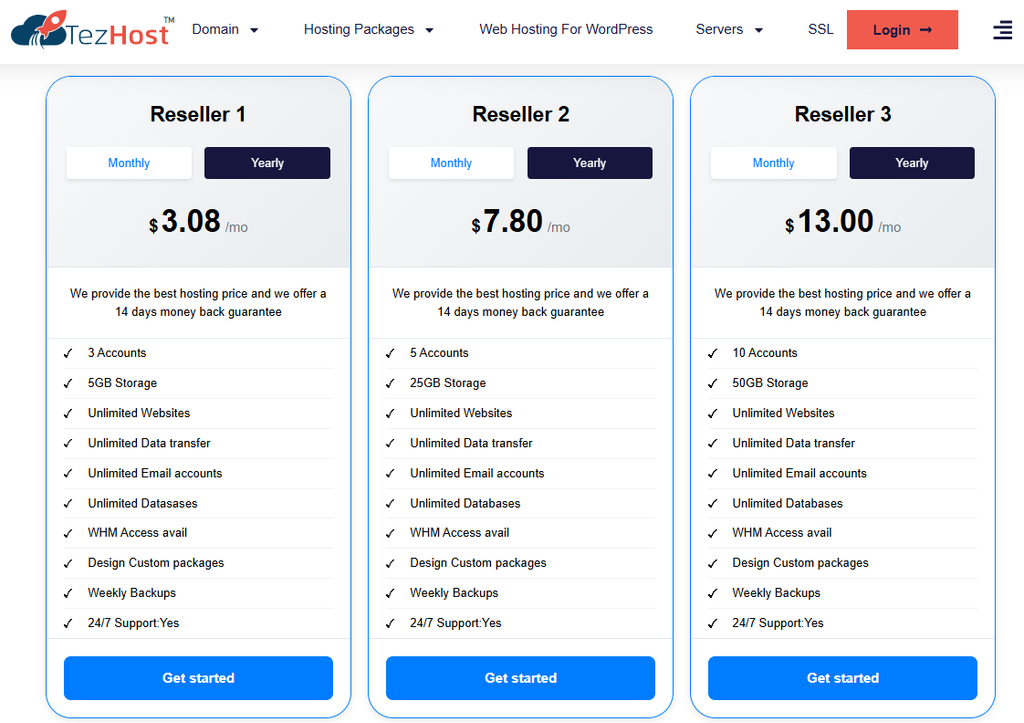
A new entrepreneur can start with Reseller Hosting.
As requirements increase, they can explore Cloud Servers, VPS infrastructure, cPanel hosting, or dedicated servers.
This flexibility is particularly valuable for someone building a cloud hosting business as a side gig.
TezHost’s approach is also focused on making hosting part of a broader digital ecosystem rather than treating it as simply server space.
Domains, hosting, cloud infrastructure, migrations, security, and support can all become part of the customer’s journey.
The company is also looking toward the future of reseller hosting as the industry evolves. Read Future Trends and Predictions of Reseller Hosting to explore where the reseller model is heading.
For anyone considering this business model, you can talk directly to a TezHost sales agent and discuss which infrastructure or reseller option may fit your requirements.
Common Mistakes to Avoid When Starting a Cloud Hosting Business
A cloud hosting business can be a good side venture, but several mistakes can make it unnecessarily difficult.
Starting Too Big
Don’t purchase expensive infrastructure before you have customers.
Competing Only on Price
Cheap hosting alone isn’t a sustainable competitive advantage.
Ignoring Support
Your customers will judge your business by how you respond when something goes wrong.
Offering Too Many Plans
Keep your packages simple at the beginning.
Forgetting Renewals
Hosting is recurring. Build a clear renewal process from day one.
Promising Unlimited Resources
Be transparent about storage, CPU, bandwidth, account limits, and acceptable use.
Not Planning for Growth
Your infrastructure should have a clear upgrade path.
Doing Everything Manually
Automate billing, provisioning, reminders, and routine administrative tasks as your customer base grows.
Frequently Asked Questions
Can I start a cloud hosting business with no technical background?
Yes. You can start a cloud hosting business through a reseller model without being a server administrator. However, basic knowledge of domains, DNS, hosting, websites, and customer support is highly beneficial.
Is cloud hosting a good side gig?
Yes, particularly for freelancers, developers, agencies, designers, and IT professionals who already have customers who need hosting. The recurring nature of hosting can complement project-based services.
Do I need to own a server to start a cloud hosting business?
No. You can start through reseller hosting and use infrastructure provided by an established hosting company. Owning or leasing dedicated infrastructure can become an option later as your business grows.
How much money do I need to start?
The amount depends on the reseller plan, domain, billing tools, branding, marketing, and other services you choose. Starting with a smaller reseller setup can reduce your initial risk.
Can I sell hosting under my own brand?
Yes. Depending on the reseller program, you can create your own hosting brand, packages, pricing, and customer-facing experience.
How do I get my first hosting customers?
Start with existing website clients, freelancers, agencies, local businesses, developers, and professional contacts. Hosting can be bundled with website development, SEO, maintenance, and domain registration.
Is reseller hosting profitable?
It can be profitable, but profitability depends on pricing, customer acquisition, infrastructure costs, retention, and support requirements. It should be treated as a real business rather than guaranteed passive income.
Can I scale from reseller hosting to cloud servers?
Yes. A cloud hosting business can evolve as demand increases. You can start with reseller hosting and eventually move appropriate customers or workloads to VPS, cloud, or dedicated infrastructure.
Conclusion: Is a Cloud Hosting Side Gig Worth It?
Yes, a cloud hosting business can be a practical side gig when approached strategically.
You don’t need to build a data center on day one. You don’t need hundreds of customers immediately. And you don’t need to invest heavily in infrastructure before you know whether there is demand.
Start with a manageable reseller setup.
Find your first customers.
Create simple packages.
Automate billing and operations.
Focus heavily on customer service.
Then scale your infrastructure as your customer base grows.
For freelancers, developers, agencies, and entrepreneurs, hosting can also become a natural extension of services they already provide.
If you’re ready to explore the opportunity, register with TezHost and start evaluating the options available for your business.
And if you want help choosing the right setup, talk to a TezHost sales agent before getting started.
Your hosting business doesn’t have to start big.
It just needs to start smart.