Unexpected cloud costs can turn what looks like an affordable hosting plan into a surprisingly expensive monthly bill. And the frustrating part? Many businesses don’t realize where the extra charges are coming from until it’s time to pay.
Imagine signing up for a cloud server advertised at $20 per month.
Sounds like a great deal, right?
But when your bill arrives, it’s $65.
You check the invoice and discover additional charges for storage, bandwidth, backups, monitoring, and software licenses.
Suddenly, that affordable cloud solution doesn’t seem so affordable anymore.
The problem isn’t necessarily cloud computing. It’s not knowing what you’re actually paying for.
Cloud technology has transformed how businesses operate. It allows companies to launch applications, manage websites, store information, and expand infrastructure without purchasing expensive physical servers.
But while cloud computing offers flexibility and scalability, understanding its complete pricing structure is essential.
At TezHost, we believe businesses should be able to make informed hosting decisions without getting lost in complicated pricing structures.
Whether you’re launching a startup or upgrading your existing infrastructure, you can register with TezHost and explore cloud hosting solutions that suit your requirements.
Not sure which plan fits your budget? Talk to a TezHost sales agent before making your decision.
In this guide, we’ll uncover the hidden cost of cloud computing, explain common cloud pricing extras, and share practical ways to avoid paying more than necessary.
1. What Are the Hidden Costs of Cloud Computing?
The hidden costs of cloud computing are additional expenses beyond the advertised server price, including bandwidth overages, extra storage, backups, software licenses, security tools, and management services.
Cloud providers use different pricing models.
Some offer fixed monthly packages with defined resources, while others charge according to usage.
Neither approach is automatically better.
However, unexpected cloud costs can occur when businesses misunderstand what’s included in their hosting plan.
Common Cloud Pricing Extras
| Expense | Why It Can Cost Extra |
|---|---|
| Additional Storage | Your website or application exceeds its allocated storage |
| Bandwidth Overages | Data transfer exceeds the included allowance |
| Automated Backups | Backup storage or scheduling is billed separately |
| Software Licensing | Windows Server, control panels, or commercial applications require licenses |
| Security Services | Advanced firewalls, monitoring, or protection tools are optional paid services |
| Server Management | Administrative support may not be included |
| Additional IP Addresses | Extra IP addresses may carry separate charges |
| Resource Upgrades | Increasing CPU, RAM, or storage raises the hosting cost |
Important: Not every provider charges separately for these features. Some hosting packages include several of them in the advertised price.
That’s why comparing only the base monthly fee can be misleading.
For a detailed breakdown, read our guide on How Much Does It Cost to Run a Cloud Server?.
2. Why Do Cloud Computing Bills Become More Expensive Than Expected?
Cloud bills become more expensive when businesses consume additional resources, exceed usage limits, activate paid services, or fail to monitor their infrastructure.
Let’s explore the most common reasons behind unexpected cloud costs.
1. Bandwidth and Data Transfer Charges
Bandwidth is one of the easiest cloud expenses to underestimate.
Every time someone visits your website, downloads a file, or interacts with your application, data is transferred.
Some providers include a generous monthly allowance.
Others charge for outbound data transfer or apply additional fees after certain limits.

For example, imagine your online store suddenly receives thousands of visitors during a promotional campaign.
That’s great for business!
But if your hosting plan has limited data transfer, the increased traffic could generate additional charges.
How to avoid it: Check your bandwidth allowance, outbound transfer pricing, and overage rates before purchasing.
2. Paying for Unused Computing Resources
More CPU and RAM aren’t always better.
If your application only requires 2 GB RAM but you’re paying for 16 GB, you may be wasting money every month.
Businesses sometimes purchase oversized servers because they assume bigger configurations automatically mean better performance.
In reality, the right server size depends on your workload.
How to avoid it: Monitor actual CPU and RAM usage before upgrading.
3. Additional Storage Expenses
Storage requirements often increase as businesses grow.
Websites accumulate images, databases expand, and applications generate logs.
Cloud pricing extras may include additional storage volumes, snapshots, or higher-performance storage options.
How to avoid it: Estimate your storage growth and understand how additional capacity is billed.
4. Backup and Disaster Recovery Charges
Backups are essential for protecting business information.
However, not every cloud hosting package includes automated backups or long-term retention.
Some providers charge separately for backup storage, snapshots, and recovery services.
How to avoid it: Confirm what’s included and choose a backup strategy that balances protection with cost.

5. Software Licensing Fees
Your cloud server might be affordable, but the software running on it may not be free.
Common licensing expenses include:
- Windows Server.
- cPanel or Plesk.
- Commercial database software.
- Security applications.
- Specialized business software.

How to avoid it: Check whether your hosting price includes the operating system and software licenses you require.
6. Managed Services and Technical Support
Cloud hosting gives businesses greater control, but that control can come with additional responsibilities.
With unmanaged hosting, customers generally handle operating system updates, software installation, security configurations, and server administration.
Managed services may cost more because the provider performs some of these tasks.

How to avoid it: Compare the cost of managed hosting with the time and expertise required to maintain the server yourself.
7. Forgotten or Unused Cloud Resources
This is one of the most frustrating causes of unexpected cloud costs.
A developer creates a testing environment.
The project finishes.
Everyone moves on.
But the cloud server, storage volume, or other billable resource remains active.

Depending on the provider’s billing model, charges may continue even when nobody is using the resource.
How to avoid it: Review active resources regularly and remove anything you no longer need.
3. How Much Do Unexpected Cloud Costs Actually Add to Your Bill?
Unexpected cloud costs can increase your monthly hosting expenses significantly, depending on the services you use and how your provider calculates charges.
Let’s consider a hypothetical example.
A small business purchases a cloud server advertised at $25 per month.
Here’s what its monthly bill could look like:
| Cloud Expense | Monthly Cost |
|---|---|
| Base Cloud Server | $25 |
| Additional Storage | $8 |
| Automated Backups | $5 |
| Security Monitoring | $7 |
| Software Licensing | $10 |
| Additional Data Transfer | $5 |
| Total Monthly Cost | $60 |
That’s $35 more than the advertised server price!
Over one year:
- Advertised hosting cost: $300
- Actual hosting cost: $720
- Additional annual expense: $420
This is an illustrative example, not a TezHost quotation or a universal cloud pricing structure.
The actual difference depends on your provider, selected services, and usage.
The lesson?
Always calculate the total cost of cloud hosting, not just the advertised monthly server price.
If you’re comparing different hosting configurations, speak with a TezHost sales agent to discuss the resources your business actually needs.
4. Is Cloud Computing More Expensive Than Traditional Servers?
Cloud computing isn’t necessarily more expensive than traditional servers. The cheaper option depends on your workload, infrastructure requirements, and long-term operating costs.
One reason businesses move to the cloud is to avoid purchasing and maintaining physical infrastructure.
Traditional on-premises servers often require upfront investment in hardware, networking equipment, power, cooling, and maintenance.
Cloud hosting shifts much of that spending into recurring service charges.
However, the hidden cost of cloud computing becomes important when additional services and resource consumption increase monthly expenses.
Cloud Hosting vs. On-Premises Infrastructure
| Cost Factor | Cloud Hosting | On-Premises Servers |
|---|---|---|
| Initial Investment | Usually lower | Usually higher |
| Hardware Purchase | Provider supplies infrastructure | Business purchases hardware |
| Scalability | Often easier to scale | May require new equipment |
| Maintenance | Shared between provider and customer | Primarily handled internally |
| Electricity and Cooling | Generally included in service pricing | Paid directly by the business |
| Resource Costs | Fixed or usage-based | Hardware capacity purchased upfront |
| Software Licensing | May cost extra | May cost extra |
| Long-Term Expenses | Depend on usage and services | Depend on maintenance and hardware lifecycle |
Which Is More Cost-Effective?
For startups, growing websites, and businesses with changing resource requirements, cloud hosting can offer financial advantages.
For organizations with highly predictable workloads and existing infrastructure, on-premises servers may sometimes provide better long-term economics.
The smartest approach is to compare the total cost of ownership over several years.
For a deeper explanation, explore our Cloud Cost Comparison: Cloud vs. On-Premises.
Remember: The cheapest infrastructure today isn’t always the most economical solution tomorrow.
5. How Can Businesses Avoid Unexpected Cloud Costs?
Businesses can avoid unexpected cloud costs by selecting appropriately sized servers, monitoring usage, understanding billing terms, and reviewing additional services before purchasing.
Here are seven practical ways to control your cloud expenses.
1. Choose the Right Server Size
Don’t purchase more CPU, RAM, or storage than your application requires.
Start with a configuration that supports your workload and upgrade when necessary.
2. Understand What’s Included
Before signing up, confirm whether your package includes:
- Storage and bandwidth allowances.
- Backup services.
- Security features.
- Operating system licenses.
- Technical support.
- Additional IP addresses.
- Resource upgrade options.
3. Monitor Your Resource Usage
Regularly review CPU, RAM, storage, and network consumption.
This helps identify unnecessary spending before it becomes a recurring problem.
4. Set Spending Alerts
If your provider supports billing alerts or spending limits, configure them.
Keep in mind that a budget alert may only notify you of spending; it doesn’t necessarily stop charges.
5. Remove Unused Resources
Delete unused test servers, storage volumes, and other billable resources after confirming they are no longer needed.
6. Compare Billing Models
Fixed monthly hosting can simplify budgeting for predictable workloads.
Usage-based billing can be attractive for applications with changing demand.
Compare both models based on your actual requirements.
7. Ask Questions Before Purchasing
Sometimes, a short conversation with a hosting specialist can help you avoid selecting the wrong infrastructure.
At TezHost, we encourage customers to understand their requirements before investing in cloud resources.
Talk to our sales team to explore available cloud hosting options.
The goal isn’t simply to spend less. It’s to avoid paying for resources and services that don’t provide value to your business.
6. How TezHost Is Revolutionizing Cloud Hosting with a Smarter Approach
TezHost is helping businesses approach cloud hosting more intelligently by offering performance-focused infrastructure, flexible hosting options, and practical guidance on selecting suitable resources.
We understand that unexpected cloud costs can be particularly frustrating for startups and growing businesses.
When you’re managing marketing expenses, employee salaries, software subscriptions, and operational costs, the last thing you need is an unpredictable infrastructure bill.
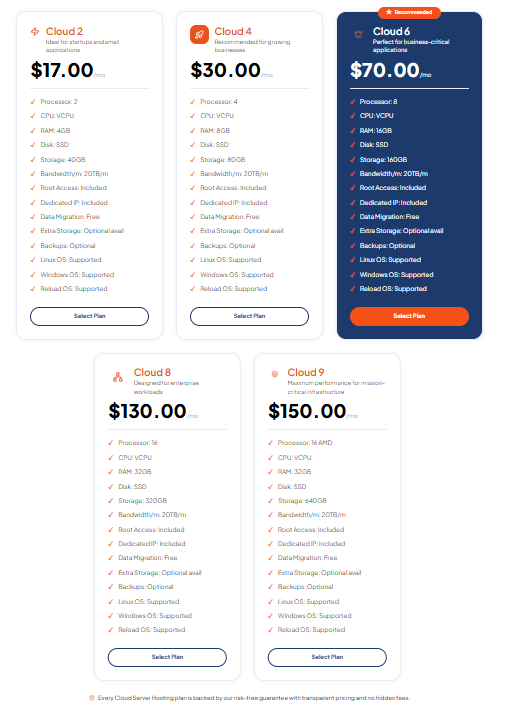
That’s why our approach focuses on helping businesses make informed hosting decisions.
Affordable Cloud Infrastructure
Not every business needs enterprise-level infrastructure.
A small application might operate efficiently on a modest server, while a growing ecommerce platform may require additional resources.
TezHost offers cloud hosting configurations for different workloads and budgets.
Instead of assuming that bigger is always better, we encourage customers to evaluate what their applications genuinely need.
Explore our Cloud Server Hosting Plans to compare available options.
Performance-Focused Technology
Modern applications require reliable computing resources.
TezHost Cloud Servers feature infrastructure technologies such as:
- AMD EPYC processors for demanding workloads.
- DDR5 RAM for responsive performance.
- Gen4 NVMe SSD storage for fast data access.
- Full root access for greater administrative control.
- Scalable configurations for growing applications.
These capabilities help businesses choose infrastructure suited to their technical requirements.
More Predictable Resource Planning
Unexpected cloud costs often begin with poor resource planning.
Businesses may purchase oversized servers, underestimate storage needs, or overlook additional services.
Our approach encourages customers to consider their expected workload, resource consumption, and budget before selecting a hosting package.
TezHost also offers published cloud server plans with defined resource allocations, helping customers compare configurations.
However, businesses should always confirm which features are included and whether any optional services or overages carry additional charges.
Flexible Hosting Options
Cloud hosting isn’t the only solution for every business.
Some websites may operate perfectly well on shared hosting.
Others may benefit from VPS hosting, cloud servers, or dedicated infrastructure.
TezHost offers multiple hosting options so businesses can choose according to their requirements.
You can also register a domain with TezHost while establishing your online presence.
Customer-Focused Assistance
Choosing a server shouldn’t feel like solving a complicated financial puzzle.
Our team helps customers explore available hosting solutions based on their applications, performance requirements, and budgets.
Why pay for infrastructure you don’t need when you could invest those resources in growing your business?
Whether you’re launching a new project or planning to migrate an existing application, we’re here to help you evaluate your options.
Connect with a TezHost sales agent today and discuss your hosting requirements.
7. What Should You Check Before Buying Cloud Hosting?
Before purchasing cloud hosting, review the complete pricing structure, included resources, upgrade costs, support coverage, and renewal terms.
The easiest way to avoid unexpected cloud costs is to ask the right questions before making a purchase.

Here’s a practical checklist:
| Question | Why It Matters |
|---|---|
| What is the total monthly price? | Helps establish your actual hosting budget |
| How much CPU and RAM are included? | Prevents unnecessary resource upgrades |
| Is bandwidth limited? | Helps avoid transfer overages |
| Are backups included? | Identifies potential recovery-related expenses |
| Are software licenses included? | Prevents unexpected licensing fees |
| Is technical support included? | Clarifies management responsibilities |
| Can I upgrade later? | Supports future business growth |
| Are there setup or renewal charges? | Helps identify additional expenses |
| What happens if I exceed my limits? | Clarifies possible overage charges |
A reliable hosting decision starts with understanding the complete package.
If you’re unsure which specifications your application requires, ask a TezHost sales agent before purchasing.
Frequently Asked Questions About Unexpected Cloud Costs
What Are the Most Common Unexpected Cloud Costs?
The most common unexpected cloud costs include bandwidth overages, additional storage, backups, software licenses, security tools, and managed services.
Actual charges depend on the provider and hosting plan.
Why Is My Cloud Computing Bill So High?
Your cloud bill may increase because of oversized servers, additional resource consumption, unused infrastructure, data transfer charges, or paid services.
Reviewing your billing details and resource usage can help identify the cause.
Is Cloud Hosting Cheaper Than Traditional Hosting?
Cloud hosting can be more cost-effective for businesses that need flexible resources or want to avoid purchasing physical servers.
However, the most economical option depends on your workload and long-term requirements.
Do Cloud Providers Charge for Bandwidth?
Some cloud providers include a fixed amount of monthly data transfer, while others charge according to usage.
Additional fees may apply when traffic exceeds the included allowance.
Are Cloud Backups Free?
Not always.
Some hosting plans include backups, while others charge separately for automated backups, snapshots, storage, or retention.
Always verify what’s included.
Can I Reduce My Cloud Hosting Bill?
Yes. You can often reduce cloud expenses by choosing appropriately sized servers, removing unused resources, optimizing storage, monitoring usage, and comparing hosting plans.
Is Fixed Monthly Cloud Hosting Better Than Pay-as-You-Go?
Fixed monthly hosting can be easier to budget for predictable workloads.
Pay-as-you-go pricing may offer advantages for applications with variable demand.
The better option depends on your usage patterns.
How Can TezHost Help Me Control Cloud Hosting Costs?
TezHost offers cloud hosting configurations for different resource requirements and budgets.
Businesses can compare available plans and discuss their infrastructure needs with the sales team before purchasing.
Explore TezHost Cloud Servers to learn more.
Conclusion: Don’t Let Hidden Cloud Costs Drain Your Budget
Unexpected cloud costs are often avoidable when businesses understand their hosting requirements, review pricing carefully, and monitor resource consumption.
Cloud computing offers tremendous advantages.
It helps businesses launch applications faster, scale infrastructure, and avoid large upfront hardware investments.
But those benefits shouldn’t come with unnecessary financial surprises.
The hidden cost of cloud computing isn’t always buried in complicated contracts.
Sometimes, it’s simply the result of paying for resources you don’t need or overlooking services that aren’t included in your plan.
That’s why choosing cloud hosting should involve more than comparing advertised prices.
Look at the complete package.
Understand your resource requirements.
Plan for future growth.
And choose infrastructure that delivers genuine value.
At TezHost, we’re committed to helping businesses explore reliable, performance-focused cloud hosting solutions without unnecessary complexity.
Ready to Take Control of Your Cloud Hosting Expenses?
Stop guessing what your cloud infrastructure should cost. Start making informed decisions.
Whether you’re launching your first cloud application or reviewing an existing hosting setup, TezHost can help you explore options that match your requirements.
Explore your cloud hosting options:
View TezHost Cloud Servers
Ready to get started?
Register with TezHost
Need help choosing the right server?
Talk to a TezHost Sales Agent
Your cloud infrastructure should support your business growth, not create unnecessary expenses.