
Choosing a domain name is one of the first decisions you make when building a website, launching a business, or creating a personal brand. But finding a name you like is only half the job. You also need to check domain availability across registrars, compare extension options, and make sure the name is worth registering.
A domain that appears available in one search tool may have different pricing, restrictions, or registration conditions elsewhere. That is why a proper domain name availability search should involve more than checking whether a name is free.
If you are ready to secure your online identity, register your domain through TezHost and explore available extensions. You can also talk to a TezHost sales agent if you need help choosing the right option.
This guide explains how to search across registrars, compare prices, understand domain extensions, and avoid common registration mistakes.
1. Start With a Clear Domain Name Shortlist
Before you check domain availability, prepare a shortlist of names that reflect your business, service, or personal brand. Searching with only one name can limit your options, especially when popular domain names are already registered.

Try creating three to five variations. Keep them short, easy to spell, and simple to remember.
For example, if your business is called “Bright Solutions”, you might consider:
- brightsolutions.com
- bright-solutions.com
- brightsolutions.pk
- brightdigital.com
- brightsolutions.net
These are examples of possible names, not confirmation that they are available.
What makes a good domain name?
A strong domain name should be:
- Easy to pronounce and spell.
- Relevant to your brand or business.
- Short enough to remember.
- Free from confusing numbers and unnecessary hyphens.
- Flexible enough to support future business growth.
A useful domain name availability search starts with a clear naming strategy. Avoid choosing a name simply because it is available. Make sure it represents the identity you want to build.
If you need more ideas, explore TezHost’s guide to choosing a domain registrar before making your decision.
2. Check Domain Availability Across Multiple Registrars
How do you check whether a domain is available? Enter the complete name, including its extension, into a registrar’s domain search tool. The tool checks registration data and indicates whether the domain can currently be registered.
For example, searching for yourbrand.com is different from searching for yourbrand.net. Each extension is a separate domain registration.

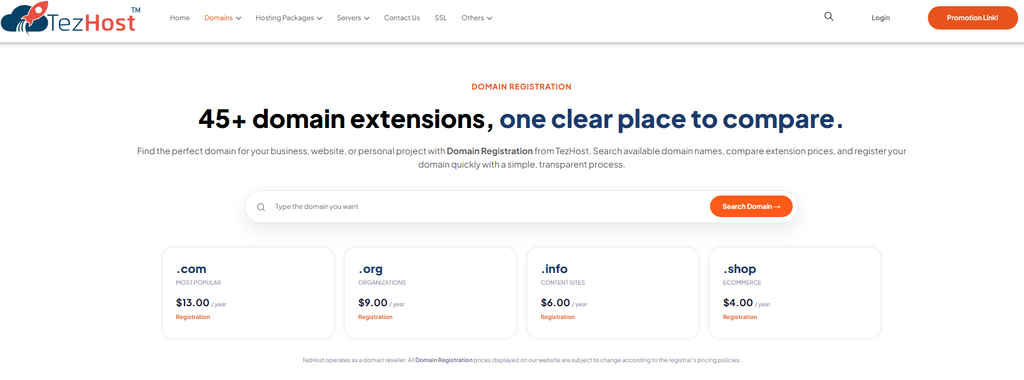
Start with a domain search tool such as the one available on the TezHost domain registration page. You can search across a range of extensions and review the options before registering.
For a broader comparison, repeat your search with other reputable registrars. This helps you identify differences in:
- Available domain extensions.
- Registration and renewal prices.
- Privacy protection options.
- DNS management features.
- Transfer policies and support.
One important point: domain search results are not a permanent reservation. Availability can change at any time. If a suitable name is available, verify the final price and registration conditions, then secure it promptly.
You can also contact TezHost sales if you need assistance with your domain search.
3. Compare Domain Extensions Before Choosing One
Finding an available name is not enough. You should also choose an extension that suits your audience and business purpose.
A domain extension, also called a top-level domain (TLD), is the part that appears after the final dot in a domain name.

Common examples include:
- .com: Widely recognised and suitable for many commercial websites.
- .net: Commonly used by technology, network, and online service businesses.
- .org: Often associated with organisations and non-commercial initiatives.
- .pk: A country-code extension for Pakistan.
- .co: Used by businesses and brands as an alternative to other popular extensions.
- .online: A flexible option for websites and digital projects.
The right extension depends on your audience, branding, eligibility requirements, and budget. Some country-code extensions have specific registration rules, so check those before proceeding.
When you check domain availability, search the same brand name with several relevant extensions. You may find that the .com version is taken while another suitable extension is available.
TezHost provides access to 45+ domain extensions, giving customers multiple options to explore. Availability and prices vary by extension.
4. Compare Registrars on More Than the First-Year Price
A low introductory price can look attractive, but it does not always represent the actual long-term cost of owning a domain.
When you compare domain registrars, review the initial registration fee, renewal price, transfer charges, and any optional services. Some providers advertise discounted first-year rates that increase at renewal.

Here is what to compare:
| Factor | What to check |
|---|---|
| Registration price | The amount charged for the first registration term |
| Renewal price | The regular cost when the domain expires |
| Transfer fee | Whether moving the domain has a charge |
| Privacy protection | Whether it is included, available, or paid |
| DNS management | Whether you can manage A, CNAME, MX, and TXT records |
| Support | How to contact the provider when something goes wrong |
| Renewal controls | Whether auto-renewal and expiry reminders are available |
For example, TezHost’s published domain pricing distinguishes between new registration, transfer, and renewal prices. Its pricing page also lists grace and redemption periods for applicable extensions. These amounts and policies can change, so check the current price for your chosen TLD before ordering.
Read our detailed domain registrar comparison to understand the factors that matter when choosing a provider.
A useful comparison should help you understand the total cost and management experience, not just the cheapest advertised offer.
5. Check Domain Ownership, History, and Brand Conflicts
An available domain is not automatically a good domain. Before registering it, check whether the name has a previous history or could create a brand conflict.
A domain may have been registered in the past and later become available again. Its previous use could matter if it was associated with spam, misleading content, or other unwanted activity.

Before completing your domain name availability search, consider these checks:
Review the domain’s registration history. Use reputable domain history or WHOIS lookup services where applicable to investigate previous registration details. Historical records may be incomplete, so do not treat them as definitive proof.
Check for existing trademarks. Search relevant trademark databases in the markets where you plan to operate. A domain being available does not mean you have the legal right to use that name as a brand.
Look for confusingly similar businesses. Search the name online and on relevant social platforms. A similar existing brand could create customer confusion.
Review the spelling and pronunciation. Say the name aloud and check whether people could easily mistype it.
These checks are especially important for businesses planning to invest in advertising, brand identity, and long-term customer recognition.
6. Verify the Domain’s Technical and Registration Requirements
Domain registration involves more than choosing a name and making payment. Different extensions can have different registration requirements, and the domain must be configured correctly after registration.

Before you check domain availability and complete an order, consider the following technical details:
- Registrant information: Use accurate contact details and keep access to the registered email address.
- Eligibility: Check whether the extension has country, residency, or business requirements.
- DNS management: Confirm that you can configure the records needed for your website and email.
- Nameservers: Understand whether you will use your hosting provider’s nameservers or a third-party DNS service.
- Domain security: Enable available account security features, including two-factor authentication where supported.
- Renewal settings: Keep renewal dates visible and make sure payment details remain current.
For example, an A record can point a domain to a web server’s IPv4 address, while MX records identify the mail servers responsible for receiving email. TXT records are commonly used for domain verification and email authentication.
A domain registrar does not necessarily provide website hosting or email hosting automatically. These are separate services that may need to be purchased and configured.
Explore TezHost domain services to review domain management features, including DNS management and available privacy options.
7. Register the Domain and Protect Your Investment
Once you have compared the available names, extensions, prices, and registration requirements, the next step is to register the domain.
Do not assume that a search result reserves a name for you. Another person or business may register it before you complete the order.

Follow this process:
- Enter your preferred domain and extension into the registrar’s search tool.
- Confirm that the exact name is available.
- Review the registration price and renewal terms.
- Check any applicable eligibility requirements.
- Enter accurate registrant information.
- Complete the registration process.
- Save your confirmation and account details securely.
- Enable available domain security and renewal settings.
If you are registering multiple names for your business, consider managing them through one organised account where practical. Keep a record of domain owners, renewal dates, DNS providers, and the services connected to each name.
If you later decide to change providers, a domain transfer may be possible. The process depends on the extension and its transfer rules. Read our guide on how to transfer a domain to a new registrar.
Ready to secure your domain? Register with TezHost or speak with our sales team for assistance.
How TezHost Is Making Domain Registration More Accessible
Choosing a domain registrar should not be a confusing process. Customers need access to suitable extensions, clear management options, transparent pricing information, and support when they need help.
TezHost brings domain registration and hosting services together, helping individuals and businesses manage important parts of their online presence through one provider.
Here is what customers can explore:
- 45+ domain extensions: Options for different brands, businesses, and online projects.
- Domain search and registration: Search for names and review available extensions through the TezHost domain platform.
- DNS management: Manage records such as A, CNAME, and MX through the available domain management tools.
- Domain privacy options: Privacy protection is available where supported and applicable.
- Bulk registration: Options for customers managing multiple domain names.
- Hosting integration: Connect domain services with shared hosting, VPS, cloud, and other hosting solutions.
- Technical assistance: Get help understanding domain management and related hosting requirements.
TezHost operates as a domain reseller and processes registrations through registrar partners. This means the underlying registrar and registry policies determine the applicable registration rules, prices, and availability.
The approach is focused on making domain registration, management, and hosting services more convenient to access together.
Explore TezHost domain registration or visit the TezHost homepage. If you need help selecting an extension or understanding the registration process, talk to a sales agent.
Frequently Asked Questions
1. How can I check domain availability for free?
You can use a registrar’s domain search tool to check whether a name is currently available. Enter the name and extension, then review the result. You can start with the TezHost domain search page.
2. Why does a domain show as unavailable on one registrar but available on another?
Search results can differ because of caching, registry updates, supported extensions, or differences in how a provider presents premium and restricted domains. Verify the result with the relevant registry or registrar before making a purchase. Do not assume that a single search result guarantees availability.
3. Can I check domain availability across different extensions?
Yes. Search the same name with extensions such as .com, .net, .org, .pk, and other relevant TLDs. Each extension is registered separately and may have different prices and eligibility rules.
4. Does an available domain mean I can use it as my business name?
Not necessarily. Domain availability does not establish trademark rights or guarantee that the name is legally safe to use. Check relevant trademark databases and existing businesses before committing to a brand.
5. What should I compare when choosing a domain registrar?
Compare registration and renewal prices, transfer fees, privacy options, DNS management, account security, support, and renewal policies. Our domain registrar comparison explains these considerations in more detail.
6. Can I register a domain without buying hosting?
Yes. Domain registration and web hosting are separate services. You can register a domain first and connect it to a hosting provider later by configuring its nameservers or DNS records.
7. Can I transfer my domain to another registrar later?
In many cases, yes. The domain must meet the applicable transfer requirements, and you may need to unlock it and obtain an authorization code. Some extensions have different procedures or restrictions. See our domain transfer guide for more information.
Conclusion: Find the Right Domain Before Someone Else Does
Your domain name is an important part of your online identity. Taking time to check domain availability across registrars helps you find suitable names, compare extensions, understand long-term costs, and avoid preventable registration problems.
Do not choose a domain based only on its first-year price or availability. Review the renewal terms, DNS controls, privacy options, registration requirements, and the reputation of the name before committing.
With the right research and a reliable provider, securing your domain can be a straightforward first step towards building your online presence.
Explore TezHost domain registration, register your preferred domain, or talk to our sales team for help getting started.